Author of How to Prep When You’re Broke and Bloom Where You’re Planted online course
It’s not often I give the most glowing endorsement possible for a book, but I want y’all to know that the guide we are talking about today has just that. We’re glowing over here. Like the sunshine.
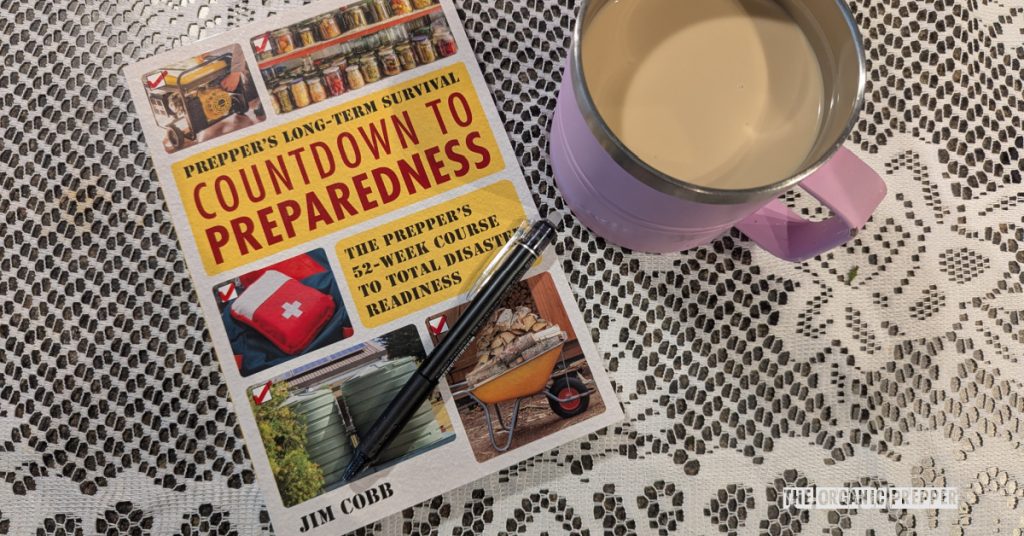
Jim Cobb has released the second edition of one of his most popular books: Prepper’s Longterm Survival Countdown to Preparedness. If you have Amazon Prime, you may be able to have this baby delivered straight to your door before the day is over.
My first thoughts
I received my copy last week as a gift, and looked forward to the read – Jim’s books are always filled with practical, no-nonsense advice.
Then, as I read, I realized this book had come at the absolute perfect time for me. The past two years have been tough for me, draining my bank account and my preps. I’m still more prepared than the average apartment dweller, I’d imagine, but nowhere near the point where I feel comfortable.
It took me two chapters to realize that I was going to do this 52-week course myself. If I have the items on the monthly lists, I’ll check them off or replenish them, depending on what they are. If I have the skills, I’ll do a quick brush-up to make sure they work as well now that I get around a whole lot differently. I realized that not only is this book great for beginners who are serious about getting prepared, it’s also fantastic for those of us who may have had to rely on our preps during hard times or who may have felt a loss of motivation.
If you get one general preparedness book this year, this needs to be the one.
Weekly assignments
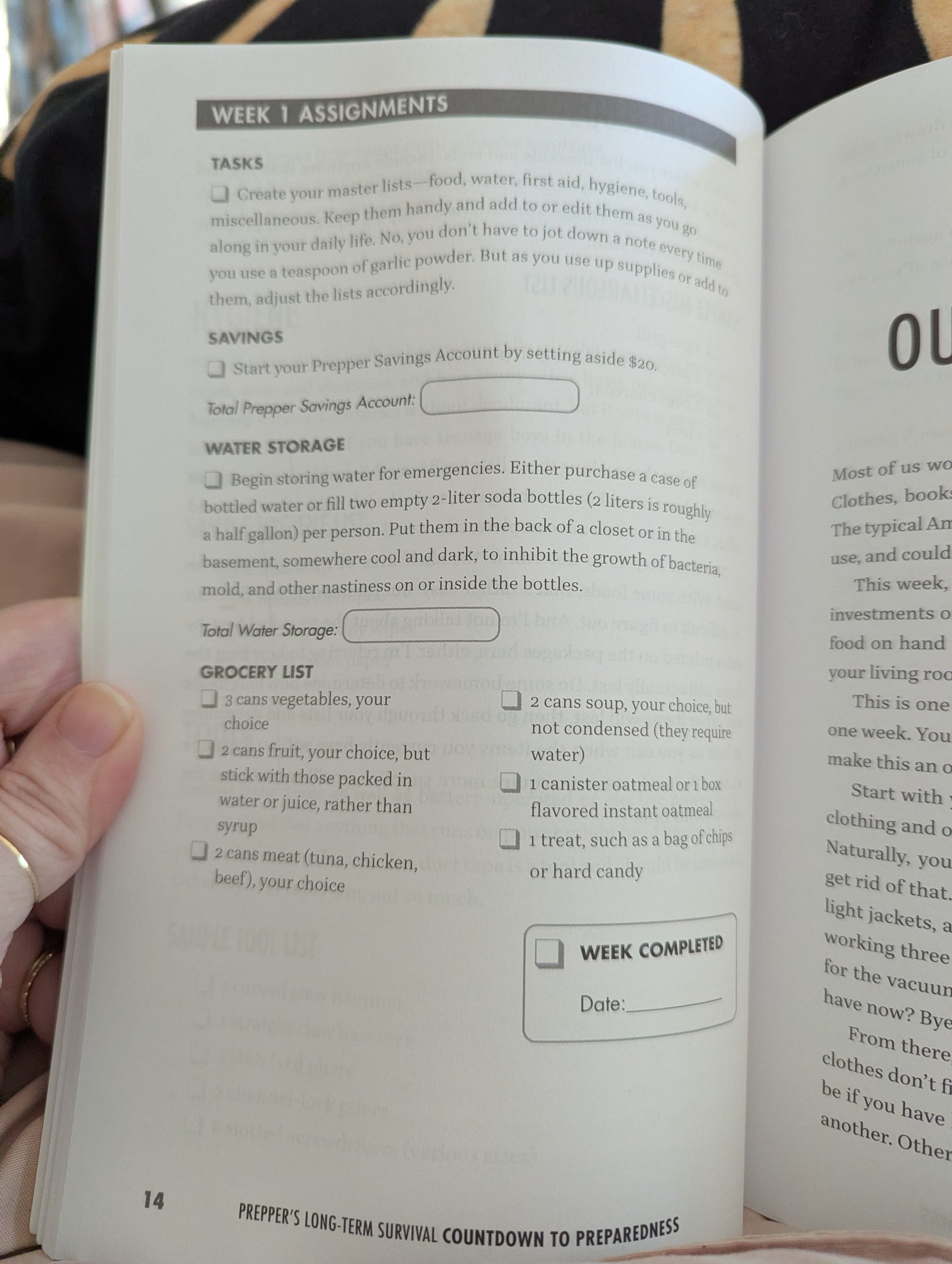
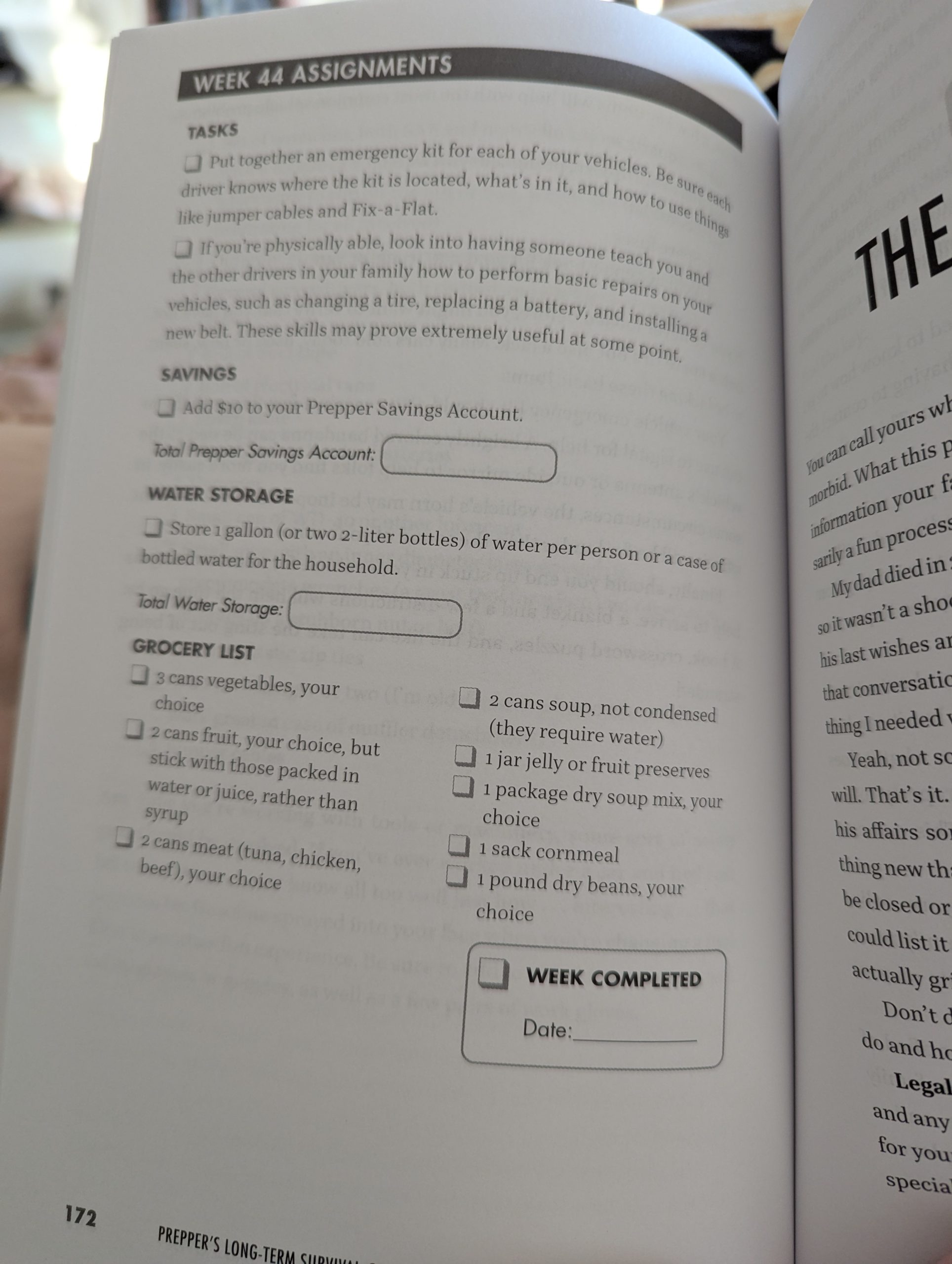
I love the weekly assignment format of this book. From week one through week fifty two and every week in between, there’s a very doable list of things to learn, do, and acquire. It’s budget-friendly, and Jim even suggests an amount of money to put into your prepper savings account some weeks to get you to the larger purchases you may need to make.
Here’s a pic of the week one assignments, and another one from week forty-four, just to give you an idea of what you’ll be doing.
This book isn’t about fear or shopping sprees or doom. It’s about practical steps absolutely anyone can take to get better prepared for the possibility of a wide variety of inconveniences and emergencies. It’s really a fantastic breakdown that anybody can follow along with.
What’s new
A lot of the things in the book are similar to those in the first edition, published back before the 2012 Doomsday clock was about to tick its last tock. Almost 25 years later, the principles are still great, but some of the details are outdated. They’ve been updated to fit our economy, lifestyles, and threats today.
Even if you have the original book, if you are planning to follow along, you may find that the new book is better suited to your life today.
This book would also make a great gift.
Do you have a loved one who is beginning to get into preparedness? Or maybe one who you hope to encourage to get better prepared? I know exactly who is getting this book as a Christmas present from me this year – a delightful young couple just setting up housekeeping and embarking on their lives together.
This is a gentle, non-doomy, practical introduction to preparedness. Everything is presented logically, without hyperbole, and any reader will find that it just makes good sense.
That’s something I love about Jim’s books. There is no scare factor. There is no “if you don’t do every single thing in this book, move to the boondocks of northern wherever, and isolate your family from society, you’re all going to die a horrible death.” You can do this stuff anywhere, anytime, and just about any budget.
A check up, a start up, a ramp up
Whether you need to check up on your preps, get started prepping, or ramp up your efforts, Prepper’s Longterm Survival Countdown to Preparedness is the book you need to do it almost effortlessly.
What do you think? Does this sound like a book for you? Does someone come to mind for gifting it to? Could your preps use a boost or a check-up?
Let’s talk about it in the comments section.






3 Responses
Hi Daisy,
I just looked on Amazon and see that there is a Kindle edition. First of all if anyone has some digital credits, they can use them and possibly get the book for “free” or a nice discount. I know I get digital credits often because I bundle my deliveries to weekly.
When I decided to have the ability to read digital books, I bought an Android tablet. It can do everything the Kindle can plus a lot more. I suppose it is the same for Apple products.
I download books from my library even when I’m 500 miles north of the Arctic Circle. Just get wifi.
It is a cost effective way to get books and if you download them to the device, even if the internet or wifi is down, you still have your book collection. I can charge it on any solar device or 12v source.
Thanks for all you do for us. This site and The Frugalite are fantastic.
That’s a great way to add to your library!
It sounds like a great book. I’ve never had much to work with but used items, one or a few new things in a month. Whatever I can do I’ve done for years. I bought 5 and 6 gallon water storage containers. Then I bought a simple hand pump for the containers sold where the round 5 gallon containers are sold next to the refill water supply in a store. # 10 cans of freeze dried meats, fruits and vegetables have been purchased one or two now and then or more if possible when they were on sale. I found some very cheap when a store was changing suppliers and selling off on hand stock. I also garden and pressure can for each years food and extra for longer term storage. Well sealed powdered milk is often in cans or Mylar pouches. I found my local food pantry most months has chili beans and beef stew in very thick Mylar bags donated from government sources. They have very long shelf life. I stored dry beans, rice, and pasta in 3 gallon food grade bakery buckets. I bought canned food when there was an annual case lot sale. It has made for a good diet and building food storage by buying carefully. I even have few bags of precooked bacon crumbles. I used one large bag finding out how I’d liked to use it. Salad topping, in greens or green beans, a handful in a pan of milk gravy, added to cornbread, in an omlet, in scrambled eggs, added to a frittata, and more. Even a Greek yogurt/mayonnaise based dip for homemade corn chips.
I bough a 25 lb bag of freeze dried diced potatoes for $12. Far cheaper than buying and preparing potatoes. I do plan to divide them up in smaller vacuum packed Mylar bags with oxygen absorbers.
I just bought more new clothing at $.50 each at an outlet store. Most will be stored sealed until needed. A few I bought with remaking in mind. Basic styles don’t change much.
I now have a hand pump made for the metal caged totes and 55 gallon drums. I have 7 totes and 10 large barrels for water for us, the chickens, 3 dogs and the scattered garden beds. Some areas will have 35 gallon plastic barrels for drip irrigation.
Camp items are a mix of new and used. I look for special things like solar powered battery chargers and rechargeable batteries for flashlights and cheap solar yard lights. I dig out bushes for new garden areas with an old firefighters matrix. A handy tool. I saved Moms spading fork. It’s better than a shovel to break up rock hard dry clay here.
Chicken food is between $17 and $25 for 40 lb bags. Cracked corn was just $9.95 this week so I bought extra. I used to buy feed at a feed mill but it was closed several years-ago. I do miss it.