By the author of How to Prep When You’re Broke and Haven Hill
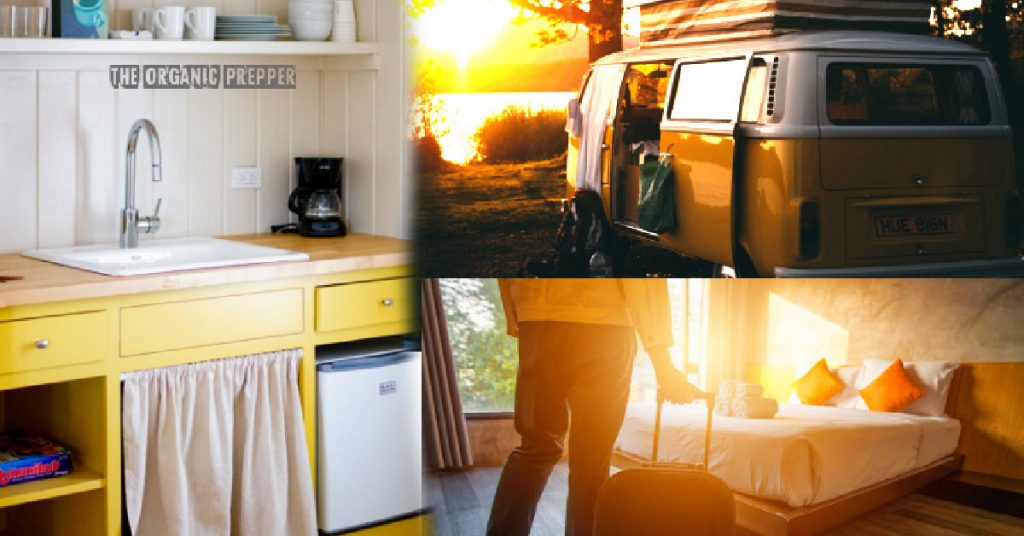
More and more people are living in temporary or mobile locations as the economy continues to falter. As the moratoriums on evictions end, the United States could soon see a wave of homelessness the likes of which has not occurred since the Dustbowl. People will be seeking shelter in temporary locations, in their vehicles, in RVs, and in campers. Many will not be leaving their homes by choice, but due to dire economic circumstances.
While you’re in for a shocking change if a nomadic lifestyle is suddenly thrust upon you, it doesn’t mean that you can’t still be prepared.
Back in 2018, I deliberately chose to be a nomad myself. After my youngest daughter left the nest, I decided to sell or give away most of my things and set out to live a nomadic lifestyle. Over the past eight years, I was fortunate enough to briefly live in Greece, Northern Macedonia, Montenegro, Bulgaria, Romania, and Mexico, and I visited many other countries in between longer stays. My goal had always been to see the world and immerse myself in other cultures. It was such a privilege to be able to do these things when I was fit and healthy, and I don’t have a moment’s regret.
My wandering ways had a lot of folks asking me, “Have you given up on prepping?”
You can still prep in temporary locations.
Prepping looks a lot different when you are in a temporary location or living in an RV/van, but it can – and should – still be done.
One very important factor in living a nomadic lifestyle is that if you pay attention, you can avoid a lot of problems or at least make things more tolerable. Here are some examples
Subscribe to our newsletter
Trying to figure out how to stock up while prices keep climbing? We can help with our free guide and newsletter!
If you live in your RV and hear that a hurricane or massive ice storm is coming in a few days, you may be able to drive your home somewhere else and avoid it altogether.
During Covid, I left Europe and went to the US to stay with one of my daughters. I was able to help her with the bills when she was unable to work. What’s more, I had a place to stay in a country where I understood the language during a very tense time in the world.
When I was in Bulgaria, some anti-American protests had begun related to their national elections. I still had a week left on my beautiful rental in the center of Sofia, but I arranged my transportation to Romania, stuck a velcro patch with a Canadian flag on my backpack as a “disguise,” and got the heck out of there.
How do you prep when you live in a temporary location?
You prep in a temporary location much like you would in a stationary location, except you pay more attention to space and transportability.
Depending on space, money, and the length of your stay, your options may be very different from what you’d choose if you lived in a home with a large pantry or storage room. When I was out there nomadding, most of the places I visited had a lower cost of living. So, I donated non-perishable food that I hadn’t eaten without feeling like I had blown a whole bunch of money. For example, in Mexico, a can of vegetables costs the equivalent of 12 cents US on sale.
When I traveled around Europe from one country to another, I didn’t have a vehicle, so everything had to fit in my luggage. Items I always had with me were those little packets of just-add-water soup and oatmeal, nuts, dried fruit, and other lightweight, uncrushable items. With those and a water filter, I could keep myself fed and watered for a few days without heading out to the grocery store. Is that an ideal diet? Of course not! But the point here is to have things on hand regardless of your situation.
If I was staying somewhere for more than a couple of months, I would be able to build a bigger stockpile.
Gear substitutes for mobile preppers
Keep in mind that when living in a temporary space, you may not have access to the same kind of gear that you would in a temporary location. I don’t have my Mr. Buddy heater, a generator, a Big Berkey, a pressure canner, or buckets and buckets of emergency food. However, I devised workarounds for the things I needed and I believe it made me a far more adaptable person.
Here are some things I didn’t have and what I use instead.
Camp stove
When I went to Selco’s Urban Survival Course in Croatia, I discovered that a lot of those little stoves are not what they’re cracked up to be. It’s very easy to create a makeshift camp stove if you only need to boil water with it. You can find two bricks or two rocks of a similar size, build a little fire between them on a fireproof surface, and set your cooking vessel on top of your rocks/bricks. That means, all I needed was a cooking vessel that could stand up to being used on an open fire.
If this is your plan, you need access to wood. When I was in Mexico, for example, I lived near the beach and couldn’t depend on finding fallen limbs on a walk. Instead, I grabbed a couple of bundles of wood for firepits and stashed them in the closet on my balcony along with a couple of cement blocks.
Heat
This, too, is location dependent. If it’s going to be frigid where you are, you need to make a better plan. I timed my locations where I’d be in warmer places in the winter, like Greece and Mexico. It’s not that difficult to stay warm if the temperature only gets down to the 50s.
In Mexico in particular, many homes do not have any type of heat and people use small propane-fueled heaters to keep warm. I was quite dubious about the use of these heaters indoors and decided to just spend the colder months there without heat. Since I had power, used the dryer and oven in the mornings to take off the evening chill.
There are also things you can do without using power to get through a chilly period of time without heat.
- Layer your clothing
- Keep slippers on your feet, especially if your floor is tiled.
- Open the curtains on the southeast side of the house for solar gain. (Sometimes, by early afternoon, this makes it so warm that you may need to open a window to cool things down a little.
- Alternatively, if your windows are north-facing, you may be better off to keep your blinds and curtains closed.
- Wear a hat. We used to call them stocking hats but I think now people call them beanies. Anyway – the knit hats that you can pull right down over your ears can make a big difference in keeping you warmer.
- Stay in one room. There’s always a room in the house that is warmer than others. I like to grab a bunch of blankets and stay in that room if it’s really cold. Block off the drafts with rolled-up towels, close the door, and light a couple of candles. I wouldn’t say that it’s exactly warm, but it’s warmer than being in a large, drafty, open space.
But you must be sensible. If the temps are below freezing and you are without any form of heat, you need to find someplace warmer to go. People can and do freeze to death inside their homes.
Water filtration.
You’re not going to lug a Big Berkey around if you are living out of a suitcase. There are numerous portable options, such as a Sawyer Mini, a Lifestraw, and a Lifestraw water bottle. The one I used the most was the water bottle. I spent the extra dollars on a metal one I could take anywhere without screaming “crazy prepper.”
I also kept little drink packets in my travel kit. One thing that a lot of preppers don’t realize is that filtered water doesn’t necessarily taste like it came from a fresh mountain stream. Some powdered lemonade mix can help cover a less pleasant flavor.
I also store water in temporary locations. I always kept some store-bought 1-3 gallon jugs on hand and was willing to leave them behind for future residents of the rental location.
Generator
I’ve written many times that instead of investing in expensive generators, I prep low-tech, and did not change when I was on the move.
I keep a solar charger that can power my laptop and phone, plus a portable charger that can recharge my phone a few times. You can also recharge devices using the USB ports in your vehicle.
Aside from this, I always have a few different flashlights, battery operated headlamps, extra batteries, and cooling cloths (these came in handy when my old Jeep nearly overheated in the desert). If you have the room (I didn’t when living out of a suitcase, but did when driving to Mexico), it’s a good idea to have a winter-rated sleeping bag and some winter cold-weather gear even if you’re going to be in a southern climate. As they learned in Texas in 2021, you never know when unusual weather might strike, and being prepared for those extremes can be as minor as staying comfortable or as major as staying alive.
What’s in my nomad pantry?
Now that the gadgets are covered, what about food? When you are nomadic or living in a short-term location, you probably won’t be able to stash away a year’s worth of supplies. I focus on at least a month, and I pay attention to my surroundings.
Back when COVID policies changed things in the US, I started shopping before the lockdown was announced. I rebuilt a food supply with a couple of trips to the store and about $500. Was it the same supply I would have had back when I had kids at home and a fixed location? Definitely not. I relied on food that didn’t require long cooking times and items I could acquire quickly. Because I did my shopping about a month before the shelves were emptied in the US, I had plenty of options and was able to get a good variety without major limitations. If I noticed an emerging crisis where I was and could not avoid it, I would stock up quickly.
Remember, one of the most important parts of being a prepper is your awareness that puts you ahead of the crowd.
I have two different types of food supplies – items for consumption or backup while I’m in transit and items that I stock up on during my stay.
My In-Transit Pantry
When I’m moving more often or traveling lightly, my pantry looks different. I have the following as the basis of my mobile pantry.
- Flavored instant oatmeal packets
- Almond or coconut milk (shelf-stable)
- Dry soup mix
- Noodle bowls
- Dried fruit
- Nuts
- Peanut butter
- Crackers
- Granola bars
- Tea
- Instant coffee packets
- Sugar packets
I can carry all of the above items in my luggage with no issues whatsoever. They’re lightweight, small, and easily portable. Aside from the crackers, none of these things are easily crushed by your other gear, either.
The quality you purchase of the above items depends upon your location and your budget. In some areas, you might be able to easily access organic versions, and in others, you may be looking at Mr. Noodle and Peanut M&Ms. Obviously, this is not a diet to sustain you for a long time, especially if you’re expending a lot of calories, but it would get you through a few days to a week. Your mileage may vary.
My Short-Term Location Pantry
When I arrived at an Airbnb or rental, I sometimes have a meal from the items in my in-transit on the first night before I go out and search for heartier fare. Once I’m settled in, I add perishables like fresh produce, bread, and meat. As well, if I’m going to be there for more than a few days, I pick up some inexpensive shelf-stable items at those locations that are too heavy or too fragile to carry around, like some of the items in the list below.
- Canned goods
- Tortillas
- Pouches of refried beans
- Crackers
- Peanut butter
- Condiments
- Tuna
- Cookies or chocolate (If I can’t leave my rental, I need some joy in my life)
- Long-lasting produce like potatoes, onions, carrots, squash, and cabbage
- Rice
- Pasta
- Meat and veggies for the freezer
- Seasonings to make everything taste better
- Coffee
- Almond milk tetras or cans of condensed milk.
Keep in mind these items never made up the majority of my diet. These are the things that I put aside in case I needed to hunker down, which happened on a couple of occasions when I was out gallivanting.
It’s all about being adaptable.
One of my major takeaways from my nomadic lifestyle is that adaptability and the willingness to be flexible are essential. And if these traits are essential just traveling, imagine how much more so they are when you’re going through difficult times.
While most folks prefer a full spice rack, a wealth of kitchen implements, and a giant storage room, the reality is that it might not be possible for everyone, particularly as the economy continues to wreak havoc on personal finances.
Sometimes, surviving may look different than you expected it to. Selco has written about leaving everything behind to survive. Fabian has written about the survival lessons to be learned from the homeless and from the Great Depression. Hopefully, we won’t see anything as extreme as those examples, but know that even if things go differently than you planned, you can still be adaptable, prepared, and resilient.
I’d love to get your thoughts in the comments section.



9 Responses
Great suggestions!
This is a warning to all preppers. Im a single disabled person. Yet I paid off my property, vehicles and began stockpiling. This is what happened. My ex-bf came back after 13 years. He and his drug buddies hiding out on my property, the X in my attic. Have been stealing everything from bottles of shampoo to whatever else they could grab, i.e., gift cards I bought for my sister’s, cash, food, clothing, jewelry, etc . If you are wise, don’t tell anyone about your preps. When the time comes, they will become monsters. Peace and blessings.
All this sounds wonderful. However, when it gets really bad it will be worse than ‘the road,’ in that extreme. My ex-bf is back hiding in my attic, stealing for his new thing my food, jewelry Christmas gift cards, clothes, money, whatever they want. The coos do Nothing! Beware.
Swell article! How about some stories of your times in other countries!
Don’t forget cash! Even in the good times one should always have some cash with you. I met a traveler who proudly showed me the tiny decorative steel cylinder pendant containing a $100 bill that he always wore on an inexpensive metal chain around his neck.
I’d be inclined to have smaller bills – no guarantee of getting change from a $100. But I agree that cash is king in more than one way. It will be law soon in my state that establishments must accept cash. I never bought the it is more “sanitary” to use a card during Covid-19.
And I agree – keep your stores to yourself. I never understood those on the Doomsday Preppers show – why advertise and make yourself a target? Staying off the radar is what we all should strive to do.
On my recent trip, I had fillups of >$100 several times. I do keep smaller bills as well as a bag of quarters for laundromats. It can be hard to find a functional one even without SHTF.
Hi, Daisy. Glad you’re back. I have a website suggestion and wasn’t sure where else to convey it.
On the home page, when the user does a mouse-over on an article title, could there be a pop-up box indicating how many comments have been posted for that article. This would avoid having to bring up the article page in order to see the number of comments. Thank you for your consideration.
Hi, David! I can look into it, but tech support right now is just me and the internet, and trust me when I tell you, that is not high-level tech support. I’ll do my best, but unless it’s a check-the-secret-box thing, I may not be able to make it happen. 🙂
Good thoughts. I too spent several years as a nomad in a number of countries during roughly the same period as you. I had to be ok with traveling lightly and being able to wing it if needed. When I spent time house/pet sitting I would assess what I had available if need be. When camping I of course was traveling very light and was mostly at risk for lack of food.
Since then I have spent several years living overseas in a country perpetually at war with ongoing missile attacks. This has resulted in a change in my view on prepping.
Back in the US when I had a home and land I was much more of a prepper that believed in acquiring several years of stored food, garden supplies, tools, ammo etc. What I have come to realize is that all of this can be taken away from you in an instant, whether it be by a flood or tornado, a missile strike or an invasion by those who want what you have. I’m not saying that having some basic supplies around such as some water, food etc isn’t important. But I think ultimately one can’t count on that. Far better to have knowledge, a network of people and a resilient nature that will help you function in a “new normal “ whatever that might be. And yes, to get yourself in as good a shape as possible with the recognition that age and disability can make things difficult.