
By Daisy Luther
What could be more wholesome than baking a loaf of homemade bread from organic ingredients, right in your own kitchen? That depends on whether you are baking it in non-toxic ovenware.
Because even when you know every single ingredient in it, sometimes that isn’t enough. Sometimes the vessel in which we are baking our food is undermining our healthy efforts by adding a very unhealthy dose of chemicals to the dishes and desserts that we prepare.
Last week, we talked about cookware and discussed perfluorinated chemicals, aluminum. and many other hazards lurking in our kitchen. (You can learn the details here.) These chemicals can be even more dangerous in the oven due to high temperatures and longer cooking time.
Of particular concern is non-stick bakeware. The per- and polyfluorinated chemicals in the non-stick coating leach into every bite of those muffins, pies, and loaves you’re baking.
That’s what we’ll talk about in this installment of the Whole Home Detox series.
A quick refresher on a few of the toxic substances to avoid
For more detailed information on these substances, check out the article on healthy cookware. Here is a quick refresher:
- Perfluorooctanoic acid (PFOA) has been linked to an increase in liver and pancreatic tumors in lab animals as well as testicular tumors and reduced fertility. PFOA is a chemical used in the manufacture of Teflon and is thought to be one of the biggest dangers associated with non-stick cookware.
- Per- and Polyfluoroalkyl Substances (PFASs) were commonly used in the manufacture of non-stick Teflon pans and bakeware such as pie and muffin tins, and as far back as 2006 the Environmental Protection Agency discussed banning such chemicals, with a total phasing out of them by 2015.If the bakeware you have at home is pre-2015 there’s a pretty good chance that they contain some of these health-harming chemicals.
- Aluminum has been connected with encephalopathy (brain malfunctions) in patients with excess load. Although the changes in the brains of these individuals are different to the malfunctions within the brain caused by conditions like Alzheimer’s, research is ongoing. Aluminum in excess can also cause a change in the permeability of cells, which can block the movement of nutrients in and out of cells. It has also been linked to a reduction of protein synthesis within the cells. (source)
Other common products
Silicone bakeware comes in a wide variety of shapes sizes and colors and according to the FDA it’s safe – but keep in mind that they said non-stick coated bakeware was safe as well and ended up retracting it years later.
Scientific American reports:
It’s sad to say, but since the use of silicone in cookware is fairly new, there has not been much research into its safety for use with food. Back in 1979 the U.S. Food and Drug Administration (FDA) determined that silicon dioxides—the basic elements in silicone cookware—were generally recognized as safe to use even in food-grade contexts. But the first silicone cookware (silicone spatulas) didn’t start to show up on store shelves until a decade later, and the FDA hasn’t conducted any follow-up studies to determine whether silicone can leach out of cookware and potentially contaminate food. For its part, Canada’s health agency, Health Canada, maintains that food-grade silicone does not react with food or beverages or produce any hazardous fumes, and as such is safe to use up to recommended temperatures.
While I can’t say this is hazardous, there just isn’t enough information yet for me to feel comfortable with it.
The Non-Toxic Bakeware Shopping Guide
Below, you can find some options that are less likely to be toxic.
Glass Ovenware
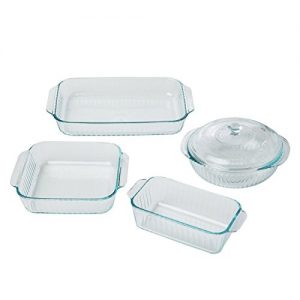 Glass bakeware is readily available. Glass has the advantage of being inert – even at high heats, it won’t add or take away anything from the food that’s baked in it. Yet another advantage? It’s very reasonably priced.
The disadvantage of glass is that you have to be careful with drastic temperature changes. For example, don’t put it in a sink of cold water until it has cooled down, and don’t put it straight into a hot oven from the refrigerator. Shattered glass isn’t something you want all over your kitchen. Another disadvantage is that foods can really stick to glass. Be sure to grease your glass cookware before adding the food.
Some good glass bakeware options:
- Pyrex 5-piece bakeware set
- Anchor Hocking 15-piece set
- Cute retro covered casserole dishes
- Glass ring cake pan
Stone Bakeware
Stone bakeware is becoming more mainstream these days. 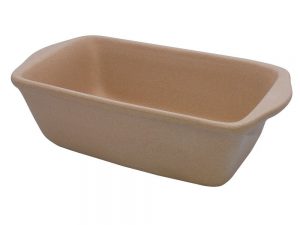
Stoneware is actually made of clay, a material that has been used to make cooking pots since time immemorial. Often dipped in a ceramic glaze to seal it, stoneware comes in a variety of colors so you can even coordinate your kitchen.
Stoneware cooks food evenly due to its excellent heat distribution. In fact, it holds the heat so well food will often continue cooking for a short while after the dish removed from the oven. Because of this property, it may take some experimentation so that dry-textured baked goods don’t overcook.
You should not immerse stone bakeware in water and you shouldn’t use soap on it. Simply wipe it clean with a damp cloth.
Stone bakeware recommendations
- Stoneware loaf pan
- Stoneware muffin pan
- Stoneware cookie sheet
- Stoneware toaster oven pan
- Pizza stone (This makes the most wonderful, crispy pizza crust!)
Ceramic-Coated Bakeware
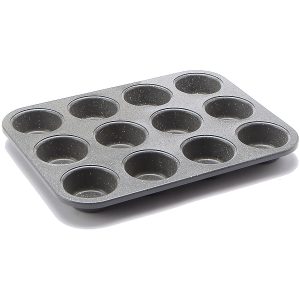 According to the website Cookware Advisor, the good quality ceramic-coated cookware will not emit toxic fumes even if heated to very high levels, contains no toxic chemicals, and is made of an inorganic, sand-like mineral applied to the inside of metal cookware using a Sol-gel process. Dr. Andrew Weil also approves of the ceramic-coated cookware. There haven’t been any long-term studies on this, but I think that if the surface is unscathed, it is a safe choice.
The downside to ceramic-coated bakeware is that the surface is very easy to scratch. Once it has been scratched, whatever substance it is coating can leach into your food.
Some ceramic-coated bakeware suggestions:
Cast Iron
Have I mentioned how much I love cast iron yet today? Because I really love cast iron. Cast iron cookware can be used in the oven and on the stovetop, making it a very versatile addition.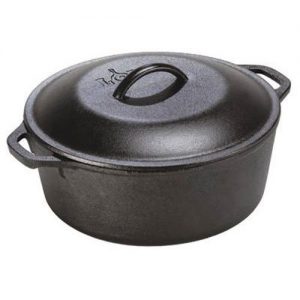
Anything made of cast iron that’s used for cooking will need to be seasoned before use. This process helps to prevent food from sticking and the iron from pitting. Some cast iron is coated with ceramic, giving you a non-stick surface. Food browns very nicely in cast iron.
The downside? Cast iron is very, very heavy, which could preclude it from being a viable option for some people.
- Cast iron muffin pan (Hey, kids! If you’re reading, my birthday is coming up. Hint hint!)
- Lodge 5-quart Dutch oven
- Lodge enamel-coated 6-quart Dutch oven
- Lodge 12-inch skillet
- Le Creuset shallow French oven (very expensive but anything by le Creuset is an investment piece)
What kind of ovenware is your favorite?
Do you have a favorite type of non-toxic ovenware that wasn’t mentioned in the article? Please share your thoughts in the comments section below.

Check Out the Other Articles in the Whole Home Detox Series
- The Healthy Baker’s Shopping Guide to Non-Toxic Ovenware
- The Healthy Cookware Shopping Guide (and What to Avoid)
- Home Detox: How to Rid Your Environment of the Sources of Chronic Illness
- Are These Dirty Little Secrets Lurking in Your Toxic Laundry Products?
- The 10 Safest Laundry Detergents (And Brands to Avoid)
- The Safest Dryer Sheets and Fabric Softeners (and the ones to avoid)










17 Responses
I’ve got a lot of glass bakeware in my storage room that I used to make 3 or 4 lasanas, or cottage pies, or mac and cheese, you get the idea, and put them in the freezer for future meals. Hubby keeps saying that I have too much….nope. I also just bought a set of cast iron ware…2 frypans, a dutch oven with feet and a recessed lid for coals, and a pot with a lid and a reversible griddle. Can’t wait to use them all. My stainless Lagostina pots are still going strong and will probably outlast me.
When I was growing up my Mother said that there was a village near hers that had a lot of dementia in the older people, and they found that they had aluminium in the water supply, so I’ve never had anything aluminium in the house.
My next purchase is some stainless cookie sheets. I have some non-stick muffin pans, but I always use a paper liner, so I think I’m ok. I haven’t had a non-stick pan in my house for over 20 years. My stainless frypans are so wonderful that I can slip an egg out just like they show in those annoying commercials.
Older cast iron isn’t as heavy. I have two 12″ skillets. One was my grandmother’s and is probably 50 years old. The other is less than 10 years old. (I inherited the older one just a few years ago.) The older one is much lighter weight. I can pick it up one handed and swing it at an intruder or fill it with food and move it from stove to oven, etc. The newer one I can also pick up one handed to swing at an intruder, however once anything at all is added to it, I need two hands, it’s just too heavy.
If you can’t get Grandma’s cast iron, watch at garage sales, thrift stores etc. They can almost always be restored with minimal effort.
Wagoner and Griswald are the big two to watch out for. I picked a set of skillets (1x 12″, 2x 10″, 3X 8″ and 2 x6″ ) what were a mix of both for $25 6 or 7 years ago.
Hi, Do you include this product – Cuisinart Cuisinart’s GG22-30 GreenGourmet Hard-Anodized Nonstick 12-Inch Open Skillet in your list of non-acceptable cookware?
Here’s their blurb – ” GreenGourmet cookware is designed with an exclusive Cuisinart Ceramica nonstick surface, which features a petroleum-free, ceramic-based coating that is applied at a temperature one half that of traditional nonsticks. The coating does not contain PTFE and PFOA, substances often used in nonstick cookware that have raised health concerns over the years. It was also developed using manufacturing techniques that reduce harmful carbon emissions by consuming less energy. The coating is also water-based, unlike other nonstick coatings on the market, which are solvent-based. In addition, Cuisinart’s cookware has a scratch-resistant nonstick surface that won’t peel off. The new cookware conforms to FDA and European RoHS standards for environmentally sound products.” Thank you!
Hi Renee. 🙂 Based on the information that I came across, this product should be fine – as long as the coating remains undamaged. I have some ceramic coated products and was surprised at how easily they scratched up – be very careful what utensils you use and how you wash them.
Oh thanks for your reply Daisy. I was especially concerned after reading your post, as this product was advertised as being made from recycled metals. Upon closer inspection it says “Additionally, the securely riveted stay-cool steel handles are manufactured using 70 percent recycled stainless steel.”
So if is just the handle I am not concerned. But I will pay attention to the cooking surface, and make sure it stays intact.
All your helpful posts are much appreciated!
It turns out the cooking surface did degrade, and food began sticking too, so I took it back to Bed Bath & B. They gave me full credit minus the 20% I got off originally, even tho no receipt and had been many months.
Are stainless steel cookware safe to use?
Yes it is.
Here’s the article on cookware. 🙂 https://www.theorganicprepper.com/the-healthy-cookware-shopping-guide-and-what-to-avoid-02102017
I have a lot of le crueset bakeware that is not cast iron but I think ceramic. Do those emit toxins or are they safe?
I did some extensive research on this one. Apparently, some of their stonewares are made in China (whilst the iron ones in France), so I don’t trust that the paint doesn’t leak . It was a pain but I decided to return the very heavy but beautiful stoneware…
I only use cast iron, stainless and glass. I have some older, well seasoned metal bread pans that I use occasionally. I bake, cook, fry and grill in my cast iron. They are my ‘heavy lifters’ in the kitchen. Literally! My cast iron made pizza is like no other. I only use stainless cooking implements, too.
Silicone makes me nervous. Too new to know the dangers, I think. I think about the fumes that substance must give off at 400 degrees. Wow! I remember all the hype about margarine and Teflon and such.
Great article. Thanks for all you do, Daisy.
I love all my Le Creuset and polish pottery. Polish Pottery is a bit pricey but worth it. Beautiful, durable heirloom pieces and completely non-toxic.
https://www.bluerosepottery.com/
https://www.artisanimports.com/
Also I finally found a ceramic non-coated crock pot that can be considered non-toxic https://www.amazon.com/Chefman-Glaze-Free-Chemical-Free-Dishwasher-Naturally/dp/B01MR0FFPS/ref=sr_1_1_sspa?ie=UTF8&qid=1511136051&sr=8-1-spons&keywords=ceramic+crock+pot&psc=1
Would you recommend Granite Ware Better Browning Bakeware? It’s made in the USA and seems like a good low cost option.
I heard the cast iron is not so great since the high heat oxidizes the iron. Please advise. Also, ceramic could be worse.
Oxidized iron is rust. It won’t hurt you.
https://www.lodgecastiron.com/bakeware-products?utm_medium=email&utm_source=Lodge+Cast+Iron+Newsletter&utm_campaign=2_22_22&utm_content=020222_2+bakeware+pieces+for+39.90_PROMO
Two pieces, $40