
By the author of The Prepper’s Canning Guide and What to Eat When You’re Broke
The best part of late summer is the glorious tomatoes. Once you’ve eaten all of the BLTs that you can hold, it’s time to start preserving tomatoes for later. Here are 10 delicious ways to prolong that taste of summer throughout the year.
Dried Tomatoes Packed in Oil
To dry tomatoes, slice them to about 1/4 inch thick and lay them on dehydrator sheets. (If you have a different type of dehydrator, you can buy netting by the roll and cut sheets to fit your unit.) If you want, you can sprinkle the tomatoes with Italian herbs, like basil and oregano. Dry them for about 8 hours at 140 degrees. Place them in a dry, sanitized jar and cover them with olive oil. Food safety experts recommend storing this in the refrigerator instead of processing it in a canner.
Dried Tomato Powder
Follow the directions above, but dehydrate the slices until they are crisp and brittle. It depends on your climate and your dehydrator how long that will take, but I’ve found that about 18-20 hours has worked for me. Allow the dried tomatoes to cool, then, using a food processor (I use the food processor container from my Ninja kitchen system for this) turn them into a powder. This stores a lot of tomato nutrition in a very small space. Add tomato powder to soups and sauces for a boost of flavor and vitamins.
Freezing Tomatoes
This is a great way to put back tomatoes if you have more freezer space than time. You can freeze tomatoes whole, with the skin on. Wash the tomatoes in a sink full of baking soda and water, then rinse them well. Place them in a gallon-sized freezer bag, and then place the bags on a cookie sheet in the freezer to allow them to freeze nice and flat for ease of storage. When it’s time to use them, place the bag in a bowl on the counter to thaw. The skins will come right off with a gentle pull, and your tomatoes are ready to use.
Prepping Tomatoes for Canning or Cooking
This article gives you the how-to for prepping tomatoes for canning. Below are a few quick recipes for canning your tomatoes, plus links to other, more involved recipes.
Canning a Simple Tomato Sauce
This thin puree is as simple as running your tomatoes through the blender and possibly adding some garlic, onions, and salt. You can use it as a base for soup, chili, spaghetti sauce, enchilada sauce, or anything else that calls for crushed tomatoes. I like to can this because it’s pretty neutral and works in so many different recipes throughout the year.
I didn’t give measurements because this simple sauce can be made from any amount of tomatoes that you happen to lay hands upon. It is also a great way to use up soft or overripe tomatoes quickly.
Ingredients:
- Peeled tomatoes (any variety)
- 1/2 a small onion per jar
- 1 clove of garlic per jar
- Sea salt or canning salt to taste
- 1 tsp. of lemon juice per quart jar
Directions:
- Peel tomatoes and place them directly into the bowl of your food processor or pitcher of your blender. Approximately 3 cups of unprocessed tomato will fill a quart jar. If you’re using onions and garlic, add those to the food processor at the same time.
- Use the pulse option on your processor until the mixture reaches your desired consistency.
- Pour this into a sanitized quart jar.
- Repeat until you have a canner load of sauce.
- Add a dash of salt to each jar. If you are water bath canning, add 2 tbsp of lemon juice to each jar. If you are pressure canning, the lemon juice is not necessary.
- In a water bath canner, process your sauce for 40 minutes at sea level, adjusting for altitude. Alternatively, you can process the sauce in your pressure canner for 25 minutes at 10 pounds of pressure, adjusting for altitude.
Straining Tomatoes for Less Waste
Instead of cooking tomatoes down for hours and letting all of that goodness just evaporate, I decided to use the same method that I use for pectin-free jam-making with some of my tomato products.
When processing tomatoes for marinara, salsa, and ketchup, cut down the cooking time and preserve the extra liquid for a vegetable broth base for soup or cooking rice.
Puree your tomatoes, then pour the puree into a lined colander that is resting over a large stockpot. (I use a flour sack towel for lining the colander.)
Let it drain anywhere from 2 hours to overnight. The longer it drains, of course, the less liquid will remain in the sauce. The liquid that drains off can then be processed as a tomato broth for soup.
You’ll be left with thick tomato-ey goodness that doesn’t require a half-day of cooking to reach the proper consistency.
Canning Tomato Broth
- Strain your liquid as described above.
- Pour this into a sanitized quart jar.
- Add a dash of salt to each jar. If you are water-bath canning, add 2 tbsp lemon juice to each jar. If you are pressure canning, the lemon juice is not necessary.
- In a water bath canner, process your broth for 40 minutes at sea level, adjusting for altitude. Alternatively, you can process the broth in your pressure canner for 20 minutes at 10 pounds of pressure, adjusting for altitude.
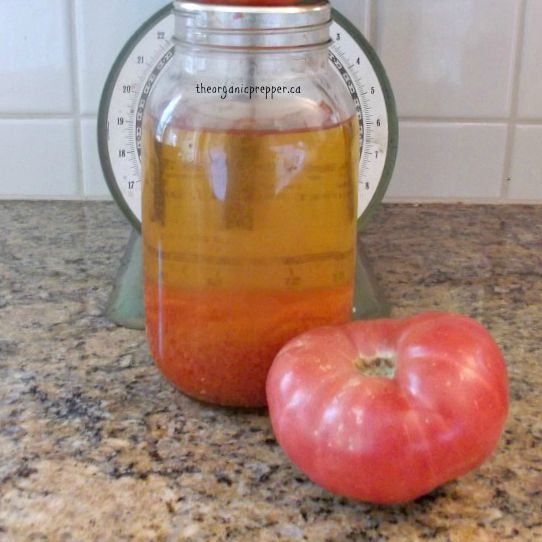
The liquid will separate, and you will have tomato “sediment” at the bottom. (See the photo) This is perfectly normal. Just shake the jar before using it to mix the liquid and the pulp. Use this broth as a base for soup, in place of liquid for cooking meat in the crock pot, or for cooking rice.
More Tomato Canning Recipes
For even more recipes, like salsa, ketchup, and barbecue sauce, check out my canning cookbook.
Recommended products
I use the following products when preserving tomatoes. (You probably already have many of these in your kitchen!)
Excelsteel 16 Quart Stainless Steel Stockpot
Presto 23-Quart Pressure Canner
Weston Food Mill (There are far less expensive food mills, but they are designed for smaller batches than you would be making when canning. That doesn’t mean you can’t use one of these – it just might be more labor-intensive.)
Water Bath Canner

Excalibur Dehydrator (There are many other fine dehydrators on the market, such as the Magic Mill one or this one by Cosori.)
How do you preserve tomatoes?
What is your favorite way to preserve tomatoes? Share with us in the comments section.












3 Responses
I put all my Roma tomatoes into a big toaster after removing the skins and let them cook at about 225. Throughout the day, I ladle off the juice and then make a Bloody Mary mix, which then gets canned – it’s delicious!
I have found that tomato skins and seeds are quite inflammatory, so I use a separating hand crank food mill to spit out the seeds and skins, which I feed to my chickens. So, wash any yuck off the tomatoes (slug juice, leaves and dirt), then cut the tomatoes into large chunks, push through the mill and crank away. I let the pulp fall into a very large mesh strainer over a bowl, then dump the pulp into a crock pot or large electric roaster. Add seasoning, onions and garlic, peppers etc, and turn on the crock pot and cover with screen splatter screens to keep the fruit flies out. Take the tomato juice and cook it down on the stove until it is reduced significantly, and add it back (with the flavor concentrated) to the sauce in the crock pot. You can cook this uncovered except for the screen, and reduce this with almost no work on your part! Just stir it occasionally, and turn down the heat as it gets thicker. Saves me so much time and effort. If you like your sauce chunky, then peel and chop some tomatoes and squeeze out the seeds, then add to the sauce. I have discovered Amish Paste tomatoes, which are huge, tastier than those bland Roma tomatoes, and have few seeds. They melt when you cook them, which is very nice when making any sauce. I also love early girl tomatoes, they taste great, are good keepers, and add more flavor to your sauce if you cook them.
I LOVE the idea for seasoning sliced tomatoes and drying them! Hadn’t thought of storing them in oil. Thanks for the tip!
Nothing “delicious” about tomatoes. Better to throw them at democrats than to save them.