
By the author of What to Eat When You’re Broke
Every once in a while, you are wandering through the internet and you come across an absolute goldmine. Then you note that goldmine, and you (if you are like me) forget about it for a week or a month or two years until you come across the note you made. But at least I have it to share with you now.
The Facebook page Mind4Survival (be sure to follow them if you’re on FB) shared a link a couple of years ago to a 1918 cookbook called Foods That Will Win the War. It can be found for free at that link on Gutenburg.org. If you are a physical copy person, I found this edition on Amazon, which is much easier to read than the rather small print on the website.
The cool thing is that a lot of this wartime food can help us with problems we face today, such as the high cost of food, shipping constraints, and inflation.
A quick history lesson on wartime food
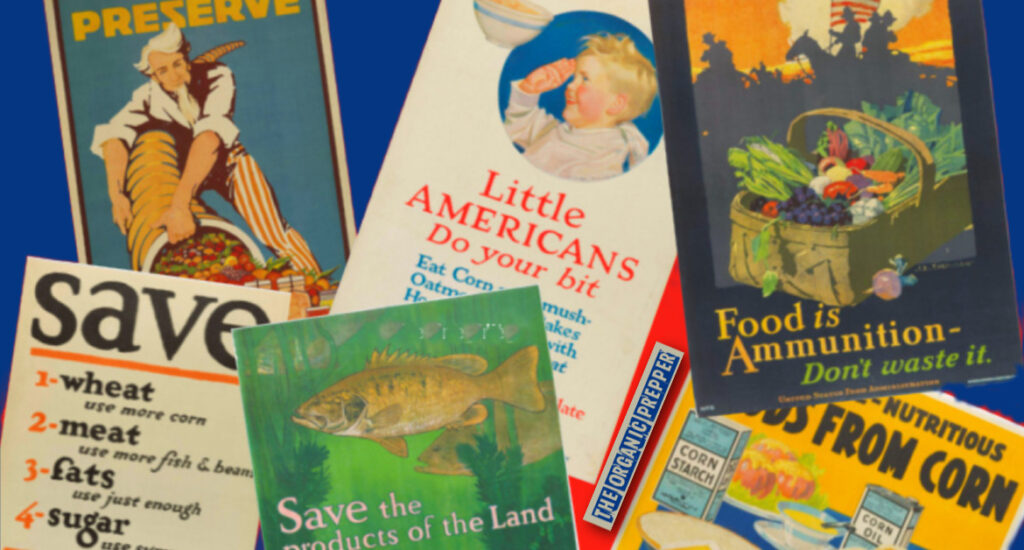
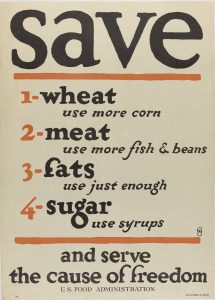 During World War I, President Herbert Hoover created the US Food Administration to change the way Americans ate so that there was enough food to fuel our soldiers. His campaign was everywhere and encouraged homegrown food as well as alternatives to regular dietary staples, using every scrap of food, and making some rather unusual choices.
“This included conserving wheat, meat, sugar, and fats, so those items could be sent overseas. The Administration advocated using alternatives like honey or molasses for sugar and corn or barley for wheat. They educated with memorable slogans, such as “when in doubt, eat potatoes” and “help us observe the Gospel of the clean plate” and invented “Meatless Mondays” and “Wheatless Wednesdays.” To free up transportation for war supplies, they encouraged buying locally produced food, or better still, growing liberty gardens.” (source)
They got women and children involved in the effort too, with the Women’s Land Army of America – a group of women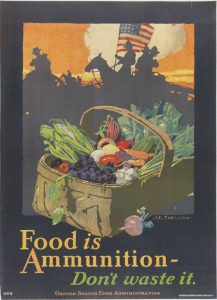 dedicated to working farm jobs formerly held by men – and United States School Garden Army, aimed at getting kids involved in food production and preservation.
Another government agency, The National War Garden Commission, presented gardening as your patriotic duty. Their goal was to “arouse the patriots of America to the importance of putting all idle land to work, to teach them how to do it, and to educate them to conserve by canning and drying all food they could not use while fresh.” Their efforts resulted in more than 5 million Liberty Gardens nationwide.
The government’s efforts focused on reducing consumption of meat, wheat, fat, and sugar so it could be shipped overseas, and eating locally so that precious fuel was also conserved. They also devoted resources to teaching people how to preserve any excess food so it wouldn’t go to waste.
While it was a massive propaganda campaign, it worked, and a lot of the advice can help with modern-day problems we’re facing right now. High prices, shortages, supply chain breakdowns, and a limited workforce means that we may need to change how we eat.
What is Foods That Will Win the War?
The book Foods That Will Win the War is based on all the premises mentioned above. In the foreword, the authors wrote:
Food will win the war, and the nation whose food resources are best conserved will be the victor. This is the truth that our government is trying to drive home to every man, woman and child in America. We have always been happy in the fact that ours was the richest nation in the world, possessing unlimited supplies of food, fuel, energy and ability; but rich as these resources are they will not meet the present food shortage unless every family and every individual enthusiastically co-operates in the national saving campaign as outlined by the United States Food Administration…
…A little bit of saving in food means a tremendous aggregate total, when 100,000,000 people are doing the saving. One wheatless meal a day would not mean hardship; there are always corn and other products to be used. Yet one wheatless meal a day in every family would mean a saving of 90,000,000 bushels of wheat, which totals 5,400,000,000 lbs. Two meatless days a week would mean a saving of 2,200,000 lbs. of meat per annum. One teaspoonful of sugar per person saved each day would insure a supply ample to take care of our soldiers and our Allies. These quantities mean but a small individual sacrifice, but when multiplied by our vast population they will immeasurably aid and encourage the men who are giving their lives to the noble cause of humanity on which our nation has embarked. (source)
The wartime cookbook offers abundant advice on conserving food, using alternative protein and grain sources, and saving things that most folks throw out. The recipes are extremely flexible, making them perfect for using what you have on hand.
What’s included in this wartime cookbook
The table of contents is below:
SAVE WHEAT: Reasons Why Our Government Asks Us to Save Wheat, with Practical Recipes for the Use of Other Grains
- A General rule for proportions in bread-making
- Use of Corn
- Use of Oats
- Use of Rye
- Use of Barley
- Use of Potatoes
- Use of Mixed Grains
- Pancakes and Waffles
SAVE MEAT: Reasons Why Our Government Has Asked Us to Save Meat, with Practical Recipes for Meat Conservation
- Selection of Meat
- Methods of Cooking 34, 35
- Charts 36, 37
- Comparative Composition of Meat and Meat Substitutes 38
- Economy of Meat and Meat Substitutes
- Meat Economy Dishes
- Fish as a Meat Substitute
- Fish Recipes
- Cheese as a Meat Substitute
- Meat Substitute Dishes
SAVE SUGAR: Reasons Why Our Government Asks Us to Save Sugar, with Practical Recipes for Sugarless Desserts, Cakes, Candies and Preserves
- Sugarless Desserts
- Sugarless Preserves
SAVE FAT: Reasons Why Our Government Asks Us to Save Fat, with Practical Recipes for Fat Conservation
- To Render Fats
- Various Uses for Leftover Fats
SAVE FOOD: Reasons Why Our Government Asks Us Not to Waste Food, with Practical Recipes for the Use of Leftovers
- A Simple Way to Plan a Balanced Ration
- Table Showing Number of Calories per Day Required by Various Classes
- Sauces Make Leftovers Attractive
- Use of Gelatine in Combining Leftovers
- Salads Provide an Easy Method of Using Leftovers
- Use of Stale Bread, Cake and Leftover Cereals
- Soups Utilize Leftovers
- All-in-one-dish Meals—Needing only fruit or simple dessert, bread and butter to complete a well-balanced menu
- Wheatless Day Menus
- Meatless Day Menus
- Meat Substitute Dinners
- Vegetable Dinners
- Save and Serve—Bread; Meat; Sugar; Fat; Milk; Vegetables
- Blank Pages for Recording Favorite Family Recipes
How to use this eBook
You can save this to your regular eBook reader but if you’re like me, you’ll want a printed copy. You have two options.
You can print it yourself. I’ve found that when I want to print out 100 pages or so, it’s far less expensive to send it over to my nearest Staples or Office Max and have it printed for 5-10 cents per page. I’d much rather use their ink than replace my expensive cartridge. Then, use a three-hole punch to put them in a binder.
You can buy it already made. Remember? I showed you this link early in the article.
What do you think of the wartime cookbook?
Did you find some creative inspiration in this wartime cookbook from 1918? Are there some recipes you’re planning to try or ones that you already make? Let’s talk about it in the comments.









8 Responses
Putting this in my SHTF library, thank you.
Hi, Daisy. This article says, “During World War I, President Herbert Hoover created….” I thought Hoover was president during the early years of the Great Depression, so I looked up who was president during WWI, and it was Woodrow Wilson.
I also left a comment saying the same thing. Woodrow Wilson was the President during WWI.
I have a small collection of war time cook books. I used to look specifically for them at the bookstore in the Smithsonian’s National Museum of American History. And homeschooling on the cheap in the DC suburbs – we spent a lot of time in DC museums.
On YouTube: WarTime Kitchen. It’s a wonderful film about this very subject. I’ve learned a lot about how & what they did to make it through.
For the last few days, the list of the five most recent comments has failed to display for me. This problem seemed to begin when Daisy’s “survival suspense” graphic was added. Has anyone else experienced this?
Oh, I’m so sorry! It’ll take me a bit but I will figure out the reason and fix it.
If you can’t afford the Amazon version; I know I can’t, you can find it on Archive.org: https://archive.org/details/b32758686