
Author of How to Prep When You’re Broke and Bloom Where You’re Planted online course
Yogurt is full of good bacteria, and it’s delicious too! But those little six-packs touting “active cultures” are also filled with other ingredients that you probably don’t want to add to your diet if the purpose of eating yogurt is good health.
Here are the ingredients in Yoplait’s plain yogurt:
Cultured Pasteurized Grade A Nonfat Milk. Contains Less Than 2% of: Corn Starch, Kosher Gelatin, Pectin. Made With Active Yogurt Cultures Including L. Acidophilus.
Corn starch and pectin are nearly always made from GMOs, so if you are trying to avoid genetically modified food, you probably don’t want to eat this yogurt. Yoplait does not promote the fact that they use rBGH-free milk, so it’s a good bet the milk is loaded with hormones. Since there are no requirements to tell us about GMOs and hormones on the labels, we have to go with the most likely scenarios.
Flavored yogurt is even worse. Here are the ingredients in Activia yogurt:
Cultured Grade A Non Fat Milk, Strawberries, Water,Modified Food Starch, Contains Less than 1% of Inulin, Acacia Gum,Modified Corn Starch, Kosher Gelatin, Pectin, Natural Flavor, Carmine(for Color), Sodium Citrate, Malic Acid, Sucralose, Calcium Lactate, Xanthan Gum, Acesulfame Potassium.
This particular flavored yogurt contains probable GMOs, chemical additives, probable rBGH-tainted milk, and artificial sweeteners.
It gets even better. Not only is homemade yogurt healthier than store-bought, it’s much less expensive, particularly if you prefer to give your family organic or raw dairy products. Here’s the math:
A gallon of milk makes approximately 2 quarts of yogurt.
- 1 gallon of organic milk is $6.99 from our local Safeway.
- 1 quart of organic yogurt is $4.99.
- By making our own yogurt, using a little of a previous batch to start the new batch, the cost per quart is only $3.50.
Something I strongly recommend for your preparedness supplies is some freeze-dried yogurt starter
It’s easy to make yogurt at home. The only issue for some folks is that it is time-consuming. While it does take time, it isn’t all hands-on time. You have to be near the stove to watch the temperature of the milk. Because of this, I usually start my milk as we’re finishing up dinner, then finish the process as I’m cleaning up the kitchen for the day. Since I’m going to be in the kitchen for an hour then anyway, it doesn’t seem like I’m spending a huge amount of time making yogurt.
There are cool little yogurt making machines
How to Make Homemade Yogurt
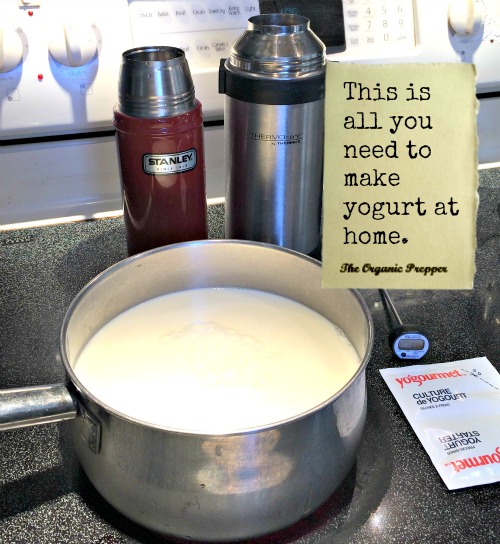
Here’s what you need:
- 1/2 gallon of milk (2 quarts)
- Culture: 1/4-1/2 cup of organic full-fat yogurt OR 2 packets of freeze dried starter
- Food thermometer (I absolutely love my digital instant read thermometer
.)
That’s it…
Directions: In a large saucepan, gently bring the milk up to 165 degrees Fahrenheit. Some people, when using raw milk, raise the temperature only to 120 so that they don’t pasteurize the milk. (However, when you turn the milk into yogurt, you’ll be adding in healthy bacteria, so this is entirely optional.)
When your milk reaches the desired temperature, remove it from the heat and allow it to cool. Be sure to remove it from the element if you have an electric stove or it will continue to get hotter. If you go over 185 degrees, your yogurt may not turn out well.
Allow your milk to cool to anywhere between 108 degrees and 112 degrees. If it is any hotter than that when you mix it with the culture, you’ll kill the bacteria that turn the milk into yogurt. If it is cooler, then it won’t be warm enough for the culturing process to occur. (This specificity is why I recommend a digital instant read thermometer
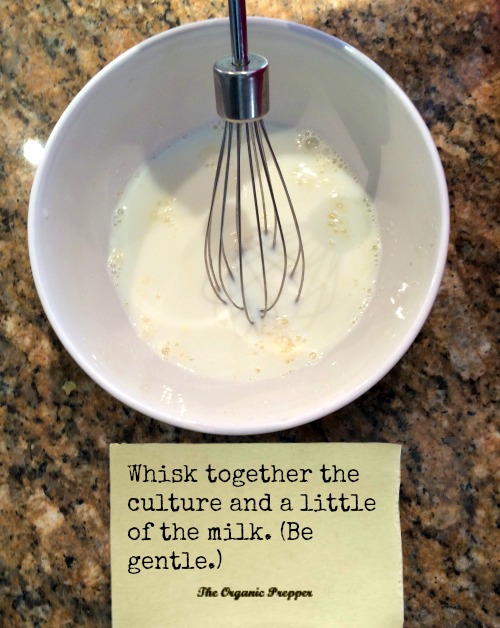
When the milk drops to the desired temperature, ladle out about a cup of it to mix in another bowl with your culture. (This can be yogurt from the store, yogurt from a previous batch, or freeze-dried starter.)
Whisk it gently to combine it thoroughly. Gently. You’re not making whipped cream or meringue. Pour the mixture back into the pot with the rest of the milk and whisk gently to combine it well.
This is where the paths of yogurt-making part, but read all the way to the end, because the paths merge again.
The Thermos Method
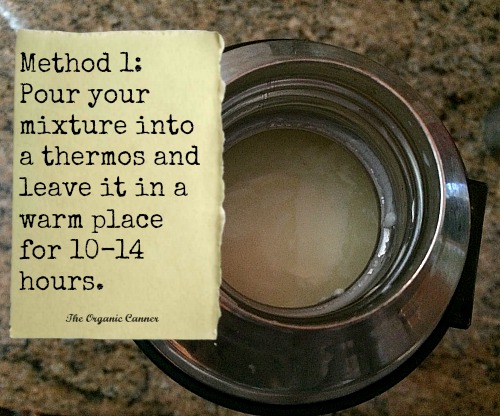 This is an off-grid way to make yogurt. It’s useful because it adds to the lifespan of your milk if the power goes out. I generally use this method because it uses no power and I like to be thrifty. Use a good quality, large thermos for this. Don’t use one of those little-kid, plastic lunch box thermoses. A thermos is a good thing to have around in a down-grid scenario, so you’ll find this to be a multipurpose item.
While you’re prepping your yogurt, fill your thermos with hot water so that the temperature inside it is nice and warm when you pour in the mixture. If the mixture cools down too quickly from meeting the chilled walls of the thermos, your yogurt will not turn out.
Empty the thermos, reserving the water for some other use. Pour or ladle the mixture from the pot into the thermos. Use a funnel to help guide the milk into the thermos. (Scroll down to the end of the article if you want a giggle about this.)
Put the lid on the thermos immediately. Leave the thermos in the warmest place in the house overnight. For us, this is the laundry room at our current home. At another home, we tucked the thermos behind the woodstove. Allow your yogurt to culture in the thermos for 10-14 hours. The longer you leave it, the more tart it will be.
(You’re not quite done. Be sure to skip down to the “Last Steps” section.)
The Dehydrator Method
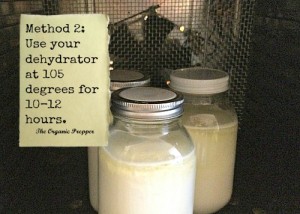
This method can be used if you have one of those nice large dehydrators with removable trays like the Excalibur
Heat up enough Mason jars to hold all of the milk you’re preparing by filling them with hot water and setting the lids on top of them.
Remove the shelves from your dehydrator and begin preheating it to 105 degrees.
When your milk has been mixed with the culture, empty the water from the jars.
Using a canning funnel, fill the jars with the yogurt-to-be, leaving an inch of headspace.
Place the lid on the jars. (I use old lids that have previously been canned with for this, since I don’t need a seal.)
Place the jars in your dehydrator and close it. Leave the temperature at 105 degrees and allow the jars to stay in for 10-12 hours. (Some instructions say 8 hours, but my yogurt was watery when I did that.) The longer the yogurt stays in the warmth, the more tart it will be.
You’re not quite done…read on.
Last Steps
 When you make homemade yogurt, it isn’t immediately going to have the super-thick texture that you get with store-bought yogurt. Some people stir in a thickener like unflavored gelatin. When you do this, you have the goodness of the whey and you don’t have to take the extra steps of draining it. However, I prefer to drain my yogurt and use the whey for other purposes.
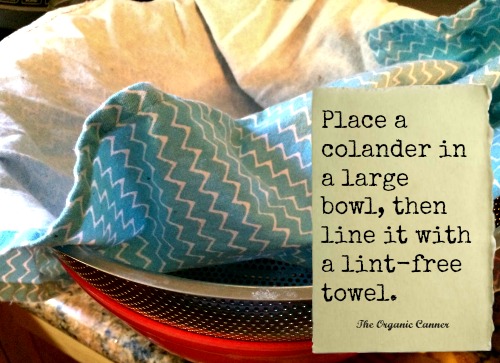
Place a large colander in a larger bowl.
Line the colander with a lint free, clean dish towel. Pour the yogurt into your draining set up. It will be very liquidy but don’t despair! Drain the yogurt for at least two hours. The longer you drain it, of course, the thicker the yogurt will be. I like to pull mine when it is the texture of sour cream, but if you leave it overnight, it will be the delicious thick consistency of cream cheese.
Here’s the spectacular result.
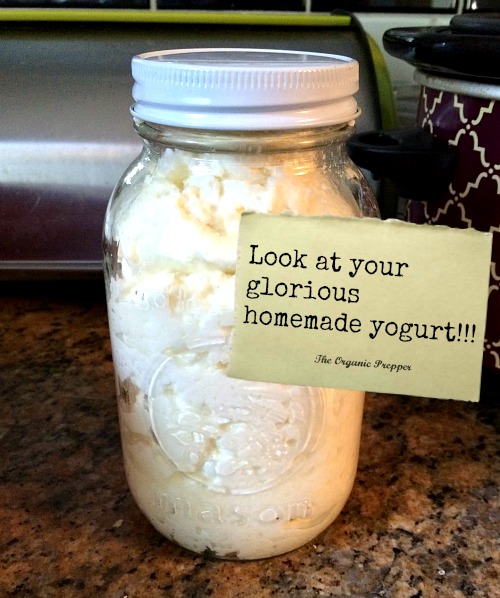
You’ll have lots of whey left over from this process. This can be used for lacto-fermentation, in place of water or milk in baking, in smoothies, or to make ricotta cheese. (Stay tuned for a ricotta recipe!)
Just so you know…
You know how websites always make things look easy and flawless? That is the magic of Bloggerland and I think sometimes it can be discouraging for those who are trying new things.
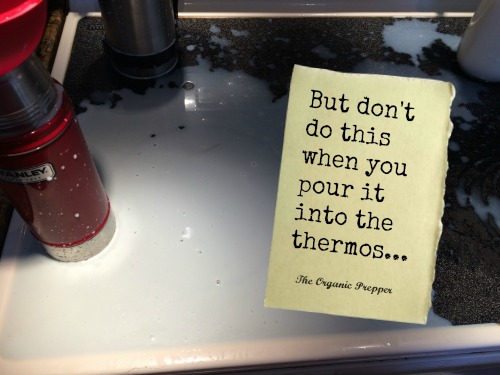
Well, just so you know that all is not actually perfect in Bloggerland, I poured from the pot to the thermos this time and used a funnel with a narrow neck. I overflowed the thermos and milk went everywhere, to the point that I had to pull out the stove and clean the floor beside and behind it.
See? I just wanted you to know that our photos on our blogs are edited to show the successes. We all try experiments that don’t work or make enormous messes from time to time. 🙂
Do you make homemade yogurt?
Do you make yogurt at home? If so, is it using one of these methods? Share how you do it and give us your best tips in the comments section.















9 Responses
When we had our cow I made yogurt and cheese all the time. Considering how much store bought yogurt and ricotta cheese, etc. cost at the time, and we didn’t have the extra money to spend on them, it felt like we were living like kings. I have one of those little yogurt makers with the 5 little cup holders but turned to using a half gallon picnic thermos jug because of the volume of milk I had to use. Never had a failure. Usually used a little from one batch to the next as starter. Those were the days.
My set up is different, it involves a heating pad, a pan of hot water, with either canning jars or a glass bowl.
I have never used a thermometer for yogurt, I just heat my milk until it bubbles around the edges, and hold it there for 5 minutes, not boiling. Cool it to “baby bottle temp” you know, where you put a few drops on your wrist and it feels nice and warm but not hot? Then I whisk in my starter. If I want a sweet vanilla yogurt, I add the sugar and vanilla into the very hot milk and stir until it is dissolved and incorporated (again, I don’ t measure, so sometimes it is really sweet…) when cooled to baby bottle temp, I whisk in my starter. Once incorporated, I have a cake pan or pot partly full of very hot water, and set a bowl in the middle. Or use small canning jars, and add fruit to the bottom, and pour in the cultured milk. Cover with a plate and wrap with a towel, and turn on the heating pad to low. Go to bed. You will have yogurt in the morning.
BTW, this is a GREAT use for that nasty tasting powder milk! Fat free yogurt which does NOT have that powder milk flavor.
I have also strained the yogurt until it was cheesy, added herbs, and rolled into small balls and stored in olive or avocado oil.
Hi, I make homemade yogurt the lazy way. I heat the milk on the stove, let it cool until just warm, mix in a little from my previous batch along with emptying some capsules of whatever probiotic I’m interested in growing, put a lid on the pan, set it in the oven with only the oven light on overnight. Next day, I strain it for several hours using a colander lined with cloth. This can be done in the refrigerator. It’s mostly hands-off. Once it’s strained, I save the whey in the freezer until I need it for a recipe and keep the thick yogurt for eating. If I want sweet, flavored yogurt, I add some sweetener of my choice and whatever fruit I’m in the mood for. I love your article. Very helpful!
Back in the day, when we were in college in the 80’s, I made my own yogurt a lot. I had invested in a yogurt maker to make it.
Our weekly food budget then was $32 a week, for two people.
Now I can make it in my Instant Pot. It takes longer for the milk to cool down before adding the starter, but that’s not a deal breaker for me.
I’ve heard that you can use plain kombucha as starter and ger a wider range of probiotics, but I have not tried that yet.
I make yogurt in my InstaPot…talk about EASY! When I pull out my last jar of homemade yogurt, I hot-foot it to a local farm and buy fresh whole milk…and start the project again. I absolutely love homemade full-fat yogurt; it tastes so much better than store bought.
I’m looking forward to making yogurt after I order some starter.
I’ve had my share of yogurt making failures and looking forward
to trying again. I’m going to try the heating pad method Gina shared.
I’m excited to make yogurt and refuse to buy it from the store.
Thank you for this post! Never made yogurt before, but I have wanted to. I had bought some heirloom Icelandic yogurt starter about a month ago that has been sitting on my kitchen counter taunting me as I contemplated purchasing a yogurt maker, buying an Instapot with the yogurt setting, or probably failing using the crockpot method that I found online. I had no idea I can use my Excalibur dehydrator to make yogurt! Your instructions are excellent and sound so easy! I am so glad that I do not have to spend money on another appliance. Looking forward to making a batch later today.
Let us know how it turns out!
You can also use some of the whey from the last batch of yogurt to make your yogurt! I just did this the other day worked really well but I use an instant pot to make my yogurt.