
By the author of Prepper’s Pantry
Most people who are working hard to eat well consume a lot of fruits and vegetables. One of the biggest issues folks noticed back when we did the Stockpile Challenge every year is getting enough produce in their diets.
It can be a major challenge when living from your stockpiled foods to get enough fruits and vegetables. This is dangerous because, without produce, your family can be at risk for nutritional deficiency diseases like scurvy and their immune systems will be compromised. A minimum of 5 servings per day is recommended, but during the long winter, how can you meet that goal with the contents of your pantry?
As well, many people these days generally eat a low-carb diet that is reliant on protein and produce. (You can get more info about stockpiling for a low-carb diet here.)
Supplying your family with produce that will provide the necessary nutrients that their bodies need to thrive is a twofold process. Not only should you preserve the summer’s bounty for the winter ahead, but you should also come up with ways to add fresh greens outside of the growing season.
These suggestions are plucked from my book, Prepper’s Pantry.
Building a Stockpile of Fruits and Vegetables
When creating your produce stockpile, you have to look at what actually constitutes a “serving” for the people you will be feeding. It may not actually be the amount that you expect. For example, a child’s serving of green beans is anywhere from a quarter cup to a half a cup (depending on their age), but an adult’s serving is a full cup. So for a child, plan on 1-3 cups of produce per day and for an adult, plan on 5 cups of produce per day.
What to Buy
At the grocery store, look for sales to build your supply of produce:
Dried: Dried fruits such as raisins, banana chips (without sugar), and dried cranberries can pack a lot of nutritional punch into a tiny serving size. Think of them as concentrated vitamins. An adult serving of raisins is only 1/4 cup, which means that you can pack a lot of nutrition into a small amount of space with dried fruits.
Canned: Canned goods such as tomatoes, green beans, and peas can go a long way towards providing nutrition. The benefit to those rows of tin cans is that you don’t require power to store them safely, and they are fully cooked so you don’t even have to heat them up in a grid down situation. You can also find many varieties of canned fruit but beware of heavy syrups. Opt for fruit canned in juice if possible.
Frozen: Frozen fruits and vegetables are the closest to fresh that you can get. This is a great way to build a stockpile for times when money is tight, but don’t put all of your produce in the freezer. During an extended power outage, you stand to lose a large portion of your deep freeze contents. If you do purchase a large amount of produce for the freezer, have canning jars, lids, and an off-grid method for canning them if the electricity goes down for the long-term.
Freeze-dried: This is a more expensive option, but freeze dried fruits and vegetables maintain nutrients, require little storage space, and need no special storage conditions. You can add a great deal of variety to your pantry with a selection of freeze-dried ingredients, and the foods, if sealed correctly, can last up to 25 years. You can find a wide variety of freeze-dried fruits and vegetables HERE.
Preserving Fruits and Vegetables
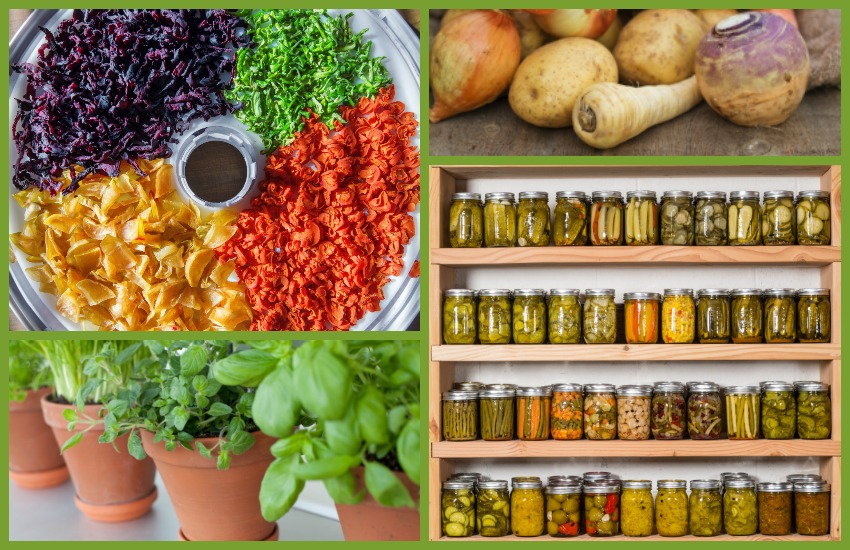
There are many effective ways to preserve fruits and vegetables that you acquire fresh. Whether you harvest them from your own property, buy them at the farmer’s market or a local orchard, or even make a bulk purchase from the discount bin at the grocery store, having the supplies and skills to quickly preserve them can allow you to make the most of your windfall. Learn more about the following methods.
- Dehydrating
- Canning
- Root Cellaring – Keep onions, potatoes, parsnips, carrots, apples, and winter squash in a cold room.
- Freeze-Drying – home freeze dryers are becoming very popular – go here for some expert advice
Indoor Gardening
There are all sorts of things you can grow indoors, even in the dead of winter. It helps to have a south-facing window and barring that, a grow light. I have had wonderful luck with spinach, lettuce, herbs, garlic, green onions, and even some teeny little radishes. I know others who have been successful with tomatoes and peppers but I have personally never managed those inside. (Maybe one day I’ll get my dream sunroom!) Some folks keep dwarf citrus trees in their homes, also.
And don’t overlook the value of sprouting. Sprouts grow incredibly quickly. They’re easy to grow and highly nutritious. You can learn absolutely everything you ever wanted to know about sprouting at this website. I like bean sprouts and microgreens the best. Each type of sprout has a very different texture and flavor.
Any tips?
Many in our community are just beginning to build their pantries. Do you have any budget-friendly tips for adding fruits and vegetables to the larder? Please share them in the comments below…
Want to learn more? Check out my book!
 Lots of us like to have hard copies of the information that we’ve found helpful. Because of this, I’ve written up everything I know about building a stockpile on a budget and put it all in one handy primer, available on Amazon.















8 Responses
Sometimes when I have the energy, and when Onions are on sale, I will cut up a bunch of them and cook them low and slow to caramelize them (autocorrect wanted that to be “carnalize”, which just made me laugh!) Then I put portions into either ice cube trays or snack sized zip locks and freeze them. Once the cubes are frozen, then you can pop them out and vacuum seal them and put back into the freezer. Use a big vacuum bag, and spread out your cubes to make them portion sized, and you can re seal the bag if you leave enough extra on the bag. I also buy the big can of tomato paste, and when I use my one-two teaspoons of it, the rest goes into a freezer bag, which is flattened, then folded so that when it freezes you can break off the right sized pieces. You can also do the ice cube tray trick.
What about growing micro greens? They pack a nutritional punch, and are easy to grow on the counter or in a window.
What about foraging? I have a stand of stinging nettle that I harvest every spring. If you don’t want to be stung by it dry, you have to dip in boiling water for a few seconds to kill the stings, then hang to dry. I have also dried it without the d-stinging process, and it can still sting you dried. If you don’t mind, go ahead and hang it. I eat a LOT of my weeds, so a good foraging book is a must if you are a beginner.
I do suggest canning and drying if you can. Food does lose some nutritional value when dried or canned, but it is better than nothing. You can also pick up pickling crocks at yard sales, just inspect for cracks and don’t buy them if there is a crack. I actually have about 4 of them, in different sizes, and have not used them because I don’t like pickles! BUT, in a SHTF situation, I would get over that dislike in favor of nutrition pretty fast! Lots of Europeans do pickled veggies as their winter source. It is an ancient practice, and doesn’t take much. Cabbage, shredded and salted, covered with a weight to keep it submerged, is the simplest form. Then you can take the kraut juice and use it to pickle other veggies. You don’t even need vinegar! You can also take those imperfect apples, wash and use the peels and cores to make cider vinegar. Look it up online, it is pretty simple. No need to buy the expensive Bragg brand when you can make it yourself.
Thank you for this. I will begin canning red potatoes and pears today from my Azure Standard order. First time canning. I am 69 and I’ve been afraid of the process. But I’m gritting my teeth and Doing it! I may dehydrate some too! BTW I loved Haven Hill!
Remember, low acid foods like potatoes MUST be pressure canned. Same for meat.
Contact your County Extension Office to learn more, or get the most recent version of the Ball Blue Book.
And don’t forget that your altitude makes a difference in canning.
I bought cabbage to do this with. I have a Mark Campbell handmade crock/weight I’ve never used!
Also you could play with kimchi recipes until you found one you like.
Thanks for all the ideas!
During the winter, there are fresh fruits and vegetables that will last several weeks or even months. These are carrots, cabbages, potatoes, onions, garlic, apples, pears, and sweet potatoes. They are all high in nutrients and will store well in the coolest, darkest, driest location in your kitchen. They also don’t break the bank.
Thank you for the article! I read every one & always get something to add or an angle to consider. Your articles have been greatly appreciated since I found you several years ago.
I am concentrating on adding some perennial veggies & herbs to my garden this year. Here in NW Florida, zone 8b/9a, things grow most of the year.
I have volunteer sweet potatoes that are on year 7, a couple of 2 year old rosemary plants to replace one that was 12 + years old, edible ginger, turmeric , comfrey & true yam roots to divide & create new beds. I transplanted baby asparagus plants into a 6ft x 3 ft tub garden & they are doing very well. Hoping to get a couple meals this year.
I ordered some tree Collard seedlings, seeds for lovage, sorrel, Good King Henry & borage. Will see if any will grow for me. I’m also replanting moringa, Seminole pumpkins, garlic & some peppers & tomatoes. Will also be adding a couple of mulberry bushes & more rose hips & blueberry bushes.
Blessings to you & the OP family.
My parents started sprouting in the late 1950s. So I grew up with mostly alfalfa sprouts available all winter. We gleaned fruit orchards after the main harvest was over with. That gave us fruit to can and dry on window screens in the shade.
As an adult I sprouted many things for winter salads and to put on sandwhiches. Fruit became harder to obtain but we’ve always grown berries along the edges of the gardens where we lived. I’ve also stopped at truck wrecks to salvage fruit and vegetables with permission from owners or tow truck drivers. Some nearer home wrecks I’ve filled my pickup multiple times. I’m also low income enough to use a community Foodbank. Often they struggle to get enough but a friend who volunteers there always lets me know when they have an over abundance of produce. Then I go. I can and sun-dried many different things. A couple of yearsago they had so much butter they gave anyone who came 18 lbs twice a month for several months. Out of desperation I canned most of that abundance. There were 4 dwarf apple trees in front of the pantry. When the apples started falling I got permission to pick three of the trees. I canned slices, applesauce, and pie filling, anpple butter, and a few jars of the juice that collected in the bowls of peeled and sliced apples. The peelings and cores became apple vinegar- 1/2 of a 5 gallon bucket of vinegar.
More recently I’ve begun working on my fiancés steep, rocky hillside property. I planted nearly 100 mixed varities of fruit trees and another area with blackberries and a few raspberries. They bloomed a bit last spring and we ate the first juicy intensely flavorful peach last fall. Birds got the few crabapples.
I’m building a raised bed for planting Everbearing strawberries in the spring. The metal rings are 5’, 4’, and 2’ across. Another area I plan to plant in ground with June berries. Some may have berries by fall but I’ll plan for the next spring.
To get enough fresh winter produce and fruit in any form takes planning and work for most of us. I don’t take state or federal help because I can pretty much find ways to provide what we need with a lot to share, trade, or sell.
My fiancé recently sold an old backhoe on an old tractor he’d bought to repair but ended up using his smaller old ford tractor and never used the larger one. The buyer was a bit short and threw in a medium Freeze dryer. We’re having fun learning to use it. A friend gave us a bag of pears. I sliced most and he dried them. Apples -hand outs from the senior center, green grapes from a truck wreck sold cheap by the man who had contracted to clean up the wreck, left overs, mixed up meatloaf still raw, pots of cooked beans with ham. I love it!
Nothing of any kind of edible is thrown out. Some dried to use later, trimmings and cores in the compost tubs, breads some vegetables, and meats- supliment the 3 dogs diets. Seeds are saved for planting or trading. Extras go to the quail up on the hillsides. Burned brush piles provide ash for some plantings.
I still make winter sprouts but with far more variety than I grew up with. The abundant saved garden seeds for things like Swiss chard, celery, radishes, green onion, lettuces, or mustards make tasty mixes. I even save seed from lambs quarters for sprouting.
Whatever is done, takes planning.
I love these ideas, particularly sprouting. Just be sure you either rotate your sprouting seeds or keep them in the freezer, and even then rotate them. They lose viability after a few years.
Also a good idea to look at how much vitamin C is left in various products after they are processed in different ways, because heat destroys that nutrient. That way you can make a good decision about preservation methods. Of course, I do keep vitamin C tablets stocked as well, just in case! I’d hate to develop scurvy.
One other word of caution – do your research on grow lights before buying one. I’ve bought several on Amazon that were not nearly as good as they claimed to be. You actually need a LOT of light energy to keep most plants healthy. So while it’s a good idea to have them, most of the cheap options won’t work well.