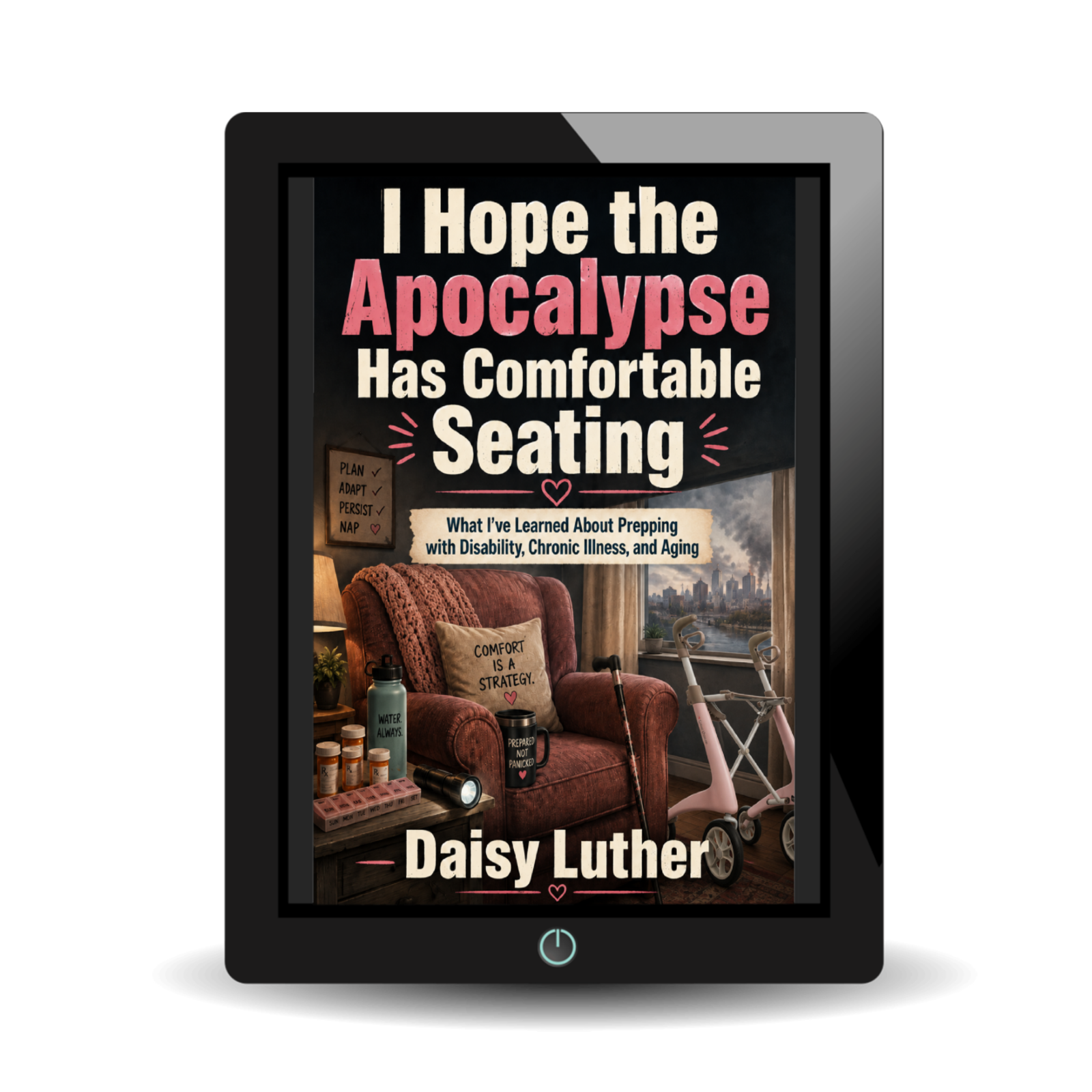
Personal Note: The following is an excerpt from my new book, I Hope the Apocalypse Has Comfortable Seating.
But before we get to that, I just want to say something that may sound harsh.
I often hear people say they’ve given up on prepping because they’re just going to die off fast anyway. You might. But you also might linger in horrible condition for way longer than you expected to.
You also might be the reason someone who loves you does not survive. I can think of a couple of reasons that might happen.
I know that my daughters would not leave me behind to flee a disaster that requires bugging out to save yourself. They would do whatever they could to evacuate me, even if that meant dragging me along in a makeshift litter. Which would, of course, be miserable for both of us. Isn’t it better for me to prepare a better way to move my ailing self, like a wheelchair?
Secondly, here’s a bugging-in scenario. I have some special dietary needs due to a chronic illness called gastroparesis. If I try to venture outside of certain foods that I know are safe, I get sick. Really sick. So I’ve prepped with these foods, which are not the foods I formerly prepped with. If I didn’t, and I ran out of safe food, I have no doubt that my loved ones would launch a daring excursion to acquire what I needed by any means necessary. Which means, of course, that they are putting themselves at risk unnecessarily when I could have prepared for this with both a short-term and long-term plan.
Before you write yourself off, think about the people who love you. Think about the fact that you probably won’t die instantly the day after your meds run out. Think about the fact that you started prepping 20 years ago for the body you had then, which is distinctly different from the body you have now, even if you aren’t dealing with mobility problems or chronic illness.
Okay – now, here’s that excerpt I told you about…
There’s More Than One Way to Survive Disasters and Dystopia
Prep for who you are now, not for who you used to be.
Preparedness advice has a way of becoming very attached to one particular image of survival.
You know the one. You’re physically strong, endlessly capable, carrying everything you need on your back, fixing broken machinery with a multitool, sleeping on the ground without complaint, and marching briskly toward safety while lesser mortals fall behind.
That version of survival exists. Sometimes the people who thrive at it have a hard time imagining that a very different survival plan could work just as well.
We know, however, that it isn’t the only version.
You can survive by staying home when everyone else is determined to flee. You can survive by leaving early because you know you’ll need more time. You can survive with a wheelchair, a cane, a rollator, a refrigerated medication, a carefully chosen diet, a stack of heating pads, or a friend who helps you load the car. You can survive by knowing your limits well enough to work around them instead of discovering them at the worst possible moment.
Sometimes survival looks less like conquering the wilderness and more like arranging your life so you don’t have to fight your own body at the same time you’re fighting the disaster.
Your Plan Doesn’t Have to Look Impressive to Anyone Else
A lot of preparedness gear photographs beautifully.
Rows of identical buckets. Tactical packs lined up on shelves. Axes. Radios. Water filters. Enough camouflage to conceal a modest subdivision.
The adaptations that make an emergency survivable for you may look much less dramatic.
- Maybe the most valuable thing you own is a shower chair.
- Maybe it’s a lightweight mobility aid you can load by yourself. (Like my beloved Lola!)
- Maybe it’s a little pouch that keeps your medication organized.
- Maybe it’s an extra pillow because you can’t sleep flat.
- Maybe it’s a rolling cart that lets you move supplies without hurting yourself.
Nobody is going to put that on the cover of *Extreme Survival Monthly*, but that doesn’t make it less important.
Useful beats aesthetically impressive every single time.
You Can Solve the Same Problem Differently
Preparedness is fundamentally a series of problems.
You need water. Food. Shelter. Safety. Medical care. Communication. Transportation. A way to manage waste. A way to stay warm or cool. A way to get through the next day without creating three new emergencies.
There is rarely only one way to solve any of them.
You’re allowed to alter the method without abandoning the objective.
That sounds obvious when written down, but people can become remarkably devoted to the “proper” way of doing things. We inherit methods from books, courses, videos, military experience, family habits, or other preppers and begin treating them as rules.
But they aren’t rules.
They’re options.
Adaptation Is a Preparedness Skill
There is enormous value in knowing how to improvise, but improvisation doesn’t always mean turning a coffee can into a stove or repairing a radio with chewing gum and optimism.
Sometimes improvisation is recognizing that the original plan no longer fits.
I’ve written before about a quotation that’s often attributed to Charles Darwin. He didn’t actually say it. It is a paraphrase from a 1963 study of Darwin’s work by professor Leon C. Megginson. But the idea applies beautifully to preparedness and especially to what we’re talking about here:
“It is not the stronger of species that survive, nor the most intelligent, but the most adaptable to change.”
Your health may change. Your mobility may change. Your living situation may change. The people around you may change. An emergency may take a completely different shape from the one you imagined.
That doesn’t mean all your previous preparation was wasted.
It means you take what still works and change the rest.
A plan you can revise is far more useful than a perfect plan you stubbornly refuse to touch.
There Are Different Kinds of Strength
Preparedness culture tends to recognize physical strength because it is easy to see.
But there’s another kind of strength that rarely shows up in the movies or the exciting works of prepper fiction.
A person who can’t lift much may have superb judgment. A person who moves slowly may notice things faster-moving people miss. Someone who has spent years managing a difficult body may already be very skilled at adaptation, planning ahead, conserving resources, and functioning under lousy conditions.
Those are survival skills too.
The Goal Is Not to Win the Apocalypse
There’s no scoreboard.
Nobody gets extra credit because they accomplished a task in the hardest possible way.
The goal is to come through the emergency with as much of yourself intact as possible.
The best preparedness plan is one that fits into the life you actually live. Not just on disaster day. Every day.
Preparedness does not have to sit in a closet waiting for civilization to wobble. Some of the best preparations quietly improve Tuesday afternoon.
What works for you now may not work forever. That is not a cheerful thought, but it’s a useful one. Your preparedness plan is a living thing that should change right along with you.
The good news is that once you stop insisting there is only one correct way to survive, you suddenly have a lot more options.
And options are useful things to have when the world gets weird.



6 Responses
Thank you Daisy for an excellent and thoughtful article.
Some of us have run a good race but are now a bit tuckered out, so your advice is well received.
Life is filled with difficult lessons but each is a learning experience. If we don’t learn, we are doomed to failure when even more difficult times come — and they surely will. We are facing critical circumstances fast approaching. My heart breaks for so many young people who are caught up in nonsensical thinking, too distracted to see what is happening right before their eyes.
I thank God that I had parents who survived through the depression. They have been gone since the mid 80s but their wisdom lives on. Though raised in the comfort and boom times of the 50s and 60s, I was always curious about what life had been like when they were growing up. So I asked plenty of questions and learned a lot. Note to young people: Talk to your elders; they know much more than you give them credit for.
Like you, I have suffered from a debilitating condition (Chron’s disease) for many years. When I was first diagnosed, my older brother who’s an MD said that I would need to have my colon removed. I am apparently a very stubborn person; I decided to tough it out. Talk about a learning process! Unfortunately, just when I think I’m completely well, I make the stupid mistake of eating something that I shouldn’t because “it tastes so good.” Last time it was garbanzo and broccoli salad. At least it didn’t land me in the hospital.
Something that I have learned fairly recently is that most of us don’t get nearly enough magnesium. The minimum daily requirement is way too low. It will keep you alive but you’ll suffer in the long run. So Daisy, load up on magnesium and see if your condition improves. I have found it helpful. Also completely remove all sugar from your diet and use stevia instead. This was a big game changer for me.
At this point, bugging out is out of the question. I will live or die in place, though I expect that I would go to my daughter’s house several miles away if threatened with a forest fire (I live in the woods.) The way I see it, if I could survive Hurricane Helene with 3 huge trees on my roof and water pouring into my living room, followed by spotty phone service for 5 days, no power and no running water for 9, plus no internet for over a month then I can survive most calamities. Yes, there are some expensive additions that would help immensely and I will just have to save up for those, but in the meantime, I’m okay and that’s good enough.
By the way, you had published a series of letters years ago from an elderly lady in England who had survived a very hard life with no running water, no electricity and no modern appliances. I think that those letters would be well worth a revisit. Thank you for all that you do to educate and inspire so many people. And it doesn’t stop with your articles. There is a “ripple effect” in action, we pass that information on to those willing to see and hear.
PS: If this is too long winded, just edit it. I won’t mind one tiny bit.
I bought this book. I really enjoyed it and learned a couple of things. I respect your honesty and willingness to work for what you need. Thank you.
Thank you so much for buying the book! I’m so glad you enjoyed it and learned something.
You are correct about adaptation. We can do it. Maybe not so willfully but we can. That is how we are going to survive. You are correct about amassing the goods and needs hoping you will be able to consume and do the things that you could even just a few yrs ago. I will be soon needing a lifelong drug from a pharmaceutical company. That really irks me and goes against all that I believe in and never wanted to rely on but so be it. We just go onto the next step.
Thank you for this well needed article.
Take care.
PreppersDailyNews.com seems to have been taken over…
I no longer own that domain. I’m not sure who bought it after I let it go.