
Author of How to Prep When You’re Broke and Bloom Where You’re Planted online
There’s a fantastic treatment around for those dealing with chronic pain or pain from an injury, and it doesn’t require any input from Big Pharma. It’s called “dry needling” and it is generally performed by a physical therapist. Some physicians and chiropractors do it too, but please do your research and be certain the person you’ve chosen has the proper education and certification.
I’m finally getting some relief from my own chronic pain between dry needling, a prescription medication, and daily, high-quality turmeric supplements. The thing that seems to have really turned things around for me is the dry needling performed by my physical therapist each week.
What the heck is dry needling?
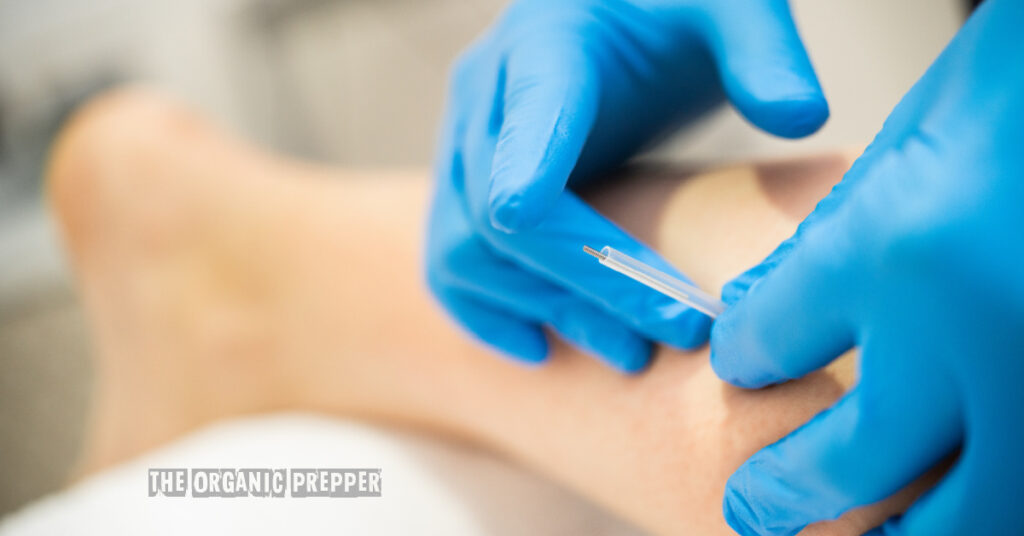
First things first, dry needling is not acupuncture. In dry needling, one needle is inserted at a time, and it is only in use while the physical therapist is manipulating that area.
What is dry needling? Here’s an explanation from the University of Georgia:
Dry Needling is a general term for a therapeutic treatment procedure that involves multiple advances of a filament needle into the muscle or connective tissue in the area of the body which produces pain and typically contains a ‘Trigger Point’. There is no injected solution or medicine, and typically the needle which is used is very thin. Most patients will not even feel the needle penetrate the skin, but once it has and is advanced into the muscle or painful region, the feeling of discomfort can vary drastically from patient to patient. Usually, a healthy muscle feels very little discomfort with the insertion of the needle; however, if the muscle is sensitive and shortened or has active trigger points within it, the subject may feel a sensation much like a muscle cramp, which is often referred to as a ‘twitch response’.
The twitch response also has a biochemical characteristic to it which likely affects the reaction of the muscle, symptoms, and response of the tissue. The patient may only feel the cramping sensation locally or they may feel a referral of pain or similar symptoms for which they are seeking treatment. A reproduction of their pain can be a helpful diagnostic indicator of the cause of the patient’s symptoms. Patients soon learn to recognize and even welcome this sensation as it results in deactivating the trigger point, thereby reducing pain and restoring normal length and function of the involved muscle.
The Journal of Orthopedic & Sports Physical Therapy clarifies it even further with the image below. It shows a different body part, but the idea is the same.
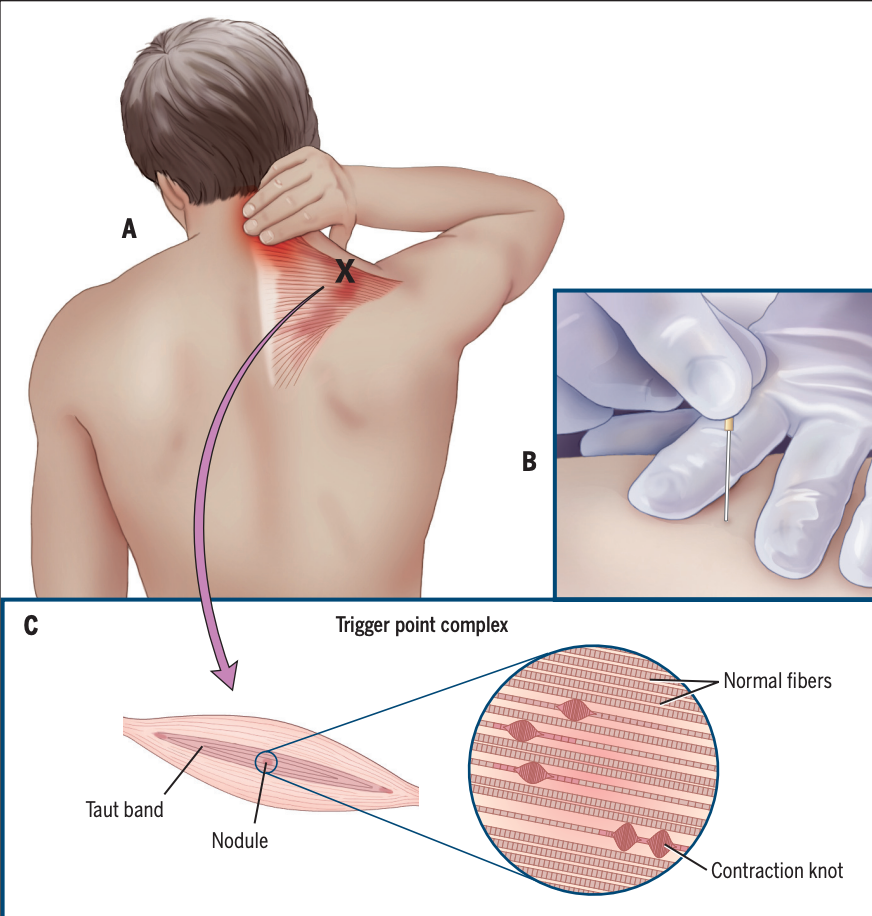
Dealing with these trigger points has greatly reduced my pain levels, and at the same time, allowed a far larger range of motion and flexibility in my ankle.
What’s it like to undergo dry needling?
When you have dry needling done, your therapist feels around in the area that may be limiting your movement. For example, when it is done for my ankle, the trigger points are in my calf muscle. When an area is extra painful when squeezed or prodded, there’s a strong chance that one of those trigger points, as illustrated above, is present. The therapist is not feeling around gently. Perish the thought.
When they find a spot that seems to be tender, they use a tiny little needle to poke into that area. You can hardly feel this needle going in through the skin, that’s how small it is. But what you can feel is when the needle hits the trigger point. Oh, boy, can you feel it! It can cause your muscles all around the needle to twitch and, not only does that feel really weird, but it’s also quite painful. With each trigger point located, the old needle is disposed of, and a new, sterile needle is used.
It can be quite painful during the treatment, but the results are rapid. Later, you feel the same kind of soreness you’d feel after a strenuous workout, in the muscle. Sometimes I end up with my foot elevated and an ice pack on it for the remainder of the day of treatment. I’m generally toast until I’ve had a good night’s sleep.
Within a day or two, the soreness subsides, and the pain is significantly reduced. I bruise easily and often have tiny little bruises where the trigger points were.
Why I recommend dry needling
Not only have I had near-miraculous results from this, but it is a drug-free treatment for certain types of chronic pain. In a world that is fast to prescribe, this remedy has actually worked better than most of the pain-killing drugs that have been offered to me.
It’s only one part of my treatment plan, however. I do take one prescription medication that targets damaged nerves, a daily supplement that reduces inflammation, and I undergo physical therapy twice a week. Treating the extreme pain is only part of the picture: I have a lot of muscle and exercise tolerance to rebuild. But after three years of pain and limited mobility, it’s a joy to have more flexibility and less pain.
It’s not a cure-all – I still have some pain and I am still significantly disabled. But it’s allowing me to do things that I thought were no longer possible and for that, I’m incredibly grateful.
It’s also not a wacky alternative treatment. It is a legitimate, evidence-based treatment technique that can have astounding results in pain reduction. If you want to read a study about its clinical effectiveness, check out this one.
I strongly recommend this drug-free treatment for chronic pain, if you are a candidate. Mine is provided in-office by a physical therapist. You should call ahead and confirm that the office you want to visit offers this service, as the practitioner requires a special certification.
What about you?
Have you ever had dry needling performed? Did you find it helpful? If you haven’t had it done, do you think you would give it a try?
I’d love to hear about your thoughts and experiences in the comments section.









13 Responses
This sounds like acupucture.
The main difference is that dry needling is based on modern Western medicine to treat musculoskeletal pain by inserting needles into trigger points, while acupuncture is based on traditional Chinese medicine to balance the body’s energy (qi) by placing needles along meridian lines to treat a wider range of systemic conditions.
Dry needling typically uses fewer, short-duration needles to address muscle knots, whereas acupuncture often involves more needles and longer sessions to treat both physical and mental/emotional ailments.
I HIGHLY advise dry needling! It was a great help with sciatica about 12-15 years ago.
The ‘zingers’ are something 🙂 but really get down to the interior muscles. Worth every penny!
“Zingers” is a good way to describe the insertion of the needle, but COMPLETELY worth the results! PT was typically useless for me, but dry needling was the game changer. Highly, recommend as a drug free part of any mobility healing routine.
Why not try therapy balls for myofacia tissue? It can do wonders and is not as invasive.
You can do these yourself, at any time and start with a larger softer ball and gradually work into small balls with less softness.
When done gradually I can function as and as m not out for the day. I actually like to do this before bed and can have a therapy ball on for new angry spots as I rest.
I’ve never heard of those – do you have a link for learning more?
I too have found that there are better ways to deal with chronic problems and pain that doesn’t just treat the symptoms, but also gets to the root causes of problems. I started taking a specific type of vitamin that has improved my lab numbers that I no longer have to take medication in regards to high LDL and low HDL levels as they are now normal!
Good health is the best prep of all!
It WORKS!!! After months of physical therapy and doing exercises for weeks with little to no relief. A few treatments with dry needling and 100% better.
PT never worked for me. Waste of time. Since I am active & fit anyway, felt like a total waste of time for me since I could Youtube the exercises at home.
Daisy, did they zap your needles too? It made a world of difference to ‘wake up’ my deep tissue area. I hate needles & I didn’t have an issue with this procedure. Though, I kept my eyes closed. 🙂 I would not call it invasive either.
Oh yes. OUCH during but relief after!
Hi, Daisy. I see that the volume of comments has recently been higher than usual. This is great, but one consequence is that the “most recent comments” list has been rolling over too frequently for me to see them all. Is there a way to see a longer list of most recent comments or to search for the comments in the “gap.” (Sorry for the thread hijack, but my message to your “hello” email address bounced with an “[email account] does not exist” reply.)
Hmmm – I’m not sure! I’ll have to speak to my website computer guru! Great suggestion!
Battle field acupuncture.
It was invented by a Air Force Dr who wanted to give the military a drug free alternative.
The Dr will put small “studs” in 1 of your ears . The first 5 are for the entire body, those after are to target the injury. You leave them in 5 to 10 days & then you remove them. They come out so easy.
It last about 2 weeks & helps 80% of the people.