
By the author of How to Prep When You’re Broke and The Widow in the Woods
Yesterday, I shared some information about Ehlers Danlos Syndrome, but it was more like a PSA. Today I want to talk about actually living with it.
These articles are being posted because May is Ehlers Danlos Awareness Month.
Early childhood signs
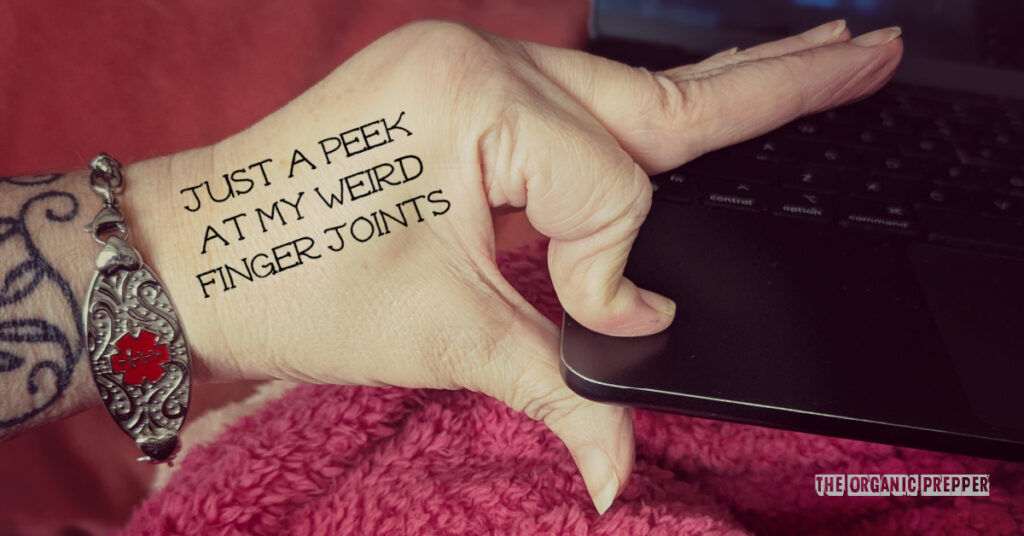
Ever since I was a child, I was “clumsy.” I’ve gotten injured in the strangest ways. I bruised incredibly easily. I dislocated fingers several times playing basketball. I held my pencils in what looked like a death grip, but I was holding it the only way I could with my overly mobile PIP joints. (My finger tips bend backward more than 90 degrees.) I twisted my ankles repeatedly.
I was involved in sports from an early age, and I’d love to say that I was a natural athlete, but it couldn’t be further from the truth. I had to practice more and work harder to maintain my spot on the basketball team. I realize now that a lot of my difficulties came from hypermobile joints. It can be hard to catch a ball when the impact bends your wrist back more than 90 degrees. Running distance always hurt, though I was fine with sprints.
After a conditioning practice, I would come home in incredible pain. I thought at the time it was a sign of me being out of shape, but that wasn’t the case. I was extremely fit from playing competitive sports for up to four hours per day. It was because running caused issues with my hip joints and every joint below that. I know now that my joints weren’t supported the way other people’s joints were and my muscles had to pull extra duty keeping them in place.
Being hypermobile doesn’t necessarily mean that you can do the splits or that you’re a born gymnast. It means that your joints bend beyond the point that they should. I had “party tricks” such as turning my thumbs around backward, touching my nose with my tongue, and other oddities. (Now, I know that doing these things is harmful, and I don’t do it deliberately.) It means you have less stability and things hurt us that don’t cause other people pain.
Subscribe to our newsletter
Trying to figure out how to stock up while prices keep climbing? We can help with our free guide and newsletter!
Adulthood
I’ve dislocated many, many joints, most of them multiple times. One of the strangest was probably the time I dislocated my hip when I was 22. I got hit by a car while I was cycling and I landed on my knee on that side when out she popped.
I hurt myself in the silliest ways, like waking up to searing pain because I just subluxated something in my sleep, partially dislocating my wrist when painting a wall, and tripping over absolutely nothing and spraining an ankle. The list goes on and on.
I was just particularly clumsy, wasn’t I? Since I’m adopted, I had no medical history that could’ve indicated there was something else going on.
But, no. It’s not about clumsiness. Not exactly. Let me explain. People with Hypermobile Ehlers-Danlos Syndrome often appear unusually clumsy because their joints are unstable and their bodies have impaired proprioception, meaning the brain has a harder time accurately sensing body position and movement in space. I think I know where my feet are, because that’s just natural to know, but sometimes I don’t, and then I wipe out.
Ligaments and connective tissues that are too loose allow joints to move beyond their normal limits, making sprains, dislocations, falls, and muscle strain far more likely during ordinary activities. As a result, seemingly harmless tasks such as getting up from the floor, reaching overhead to change a lightbulb, or even sitting awkwardly while doing a puzzle can place abnormal stress on joints and soft tissues, leading to injuries that seem bizarre and disproportionate to the activity itself.
I was fit, I did endurance sports that didn’t hurt my joints through my early 20s, like long-distance cycling, and I was always an avid hiker. Because I stayed active, even though I got more injuries than most of my friends, I never realized I had a disease that was affecting me from my unstable neck vertabrae to my wonky little toes. I had adapted so well to it that I didn’t even know it was a problem.
It wasn’t until I met a friend with EDS who said, “Hey, you should get this checked out,” that I began to think there might be something going on. But at that point, I was still very active, I was traveling a lot, and I was in love with life. I still recovered fast from injuries, so I pushed the thought aside.
Finally, things came to a grinding halt. I partially ruptured a tendon in my ankle getting off a mattress on the floor. I wish I had a better story than that, but there it is. I tried to push through it, and did for about six months, until I visited a bunch of castles on a tour in Romania and walked up and down about a zillion tiny steps that day. I was in so much pain by the end of it that when my daughter called me with a personal problem, I was happy to board a plane and immediately come back home to the US to help her through it.
It just went downhill from there.
This is a disorder you are born with, and for some subtypes, particularly the hypermobile one, diagnosis can take decades.
The first doctor I went to for my ankle injury hemmed and hawed and did cortisone shots in my ankle and foot along the tendon that was injured, telling me I needed to stay off my feet completely (aside from going to the bathroom and stuff) for two weeks. Then he’d do some other little tweak and tell me I needed to stay off my feet some more. No longer could I go for long walks or hit the grocery store with my little cart. By the time I changed doctors, the tendon had completely ruptured, and I could barely walk. My new doctor used the imaging that was already done and said that I needed a complete reconstruction and tendon transfer. He got me in within a month of our first visit, and he was wonderful.
The surgeon broke my heel and realigned my foot, then transferred a tendon from elsewhere in my foot to replace the absolutely destroyed post-tibial tendon. He told my mom and daughter in the waiting room that the tendon was very gummy in texture and was hanging on by the tiniest string. He said he was shocked I’d been able to walk into his office on that foot and he’d never seen anything quite like it.
Everything went well until I began to do physical therapy and to bear weight on that side. Then a different tendon in my foot snapped, and I had to have surgery again. (With the requisite bed rest. I also couldn’t walk after that tendon snapped, so I was in bed both before and after.)
I believe that this was a turning point, due to months of bed rest and time off my feet. Things didn’t heal properly, my active life hit a standstill, and suddenly, I was subluxing joints on almost a weekly basis. It was during this time that I got a diagnosis of hEDS, and things began to make sense.
Living with a disability
It’s been hard to go from being an extremely active person to one who must pace herself carefully and take multiple medications. Sometimes I dream that I’m in Greece or Romania, and the dreams are so real that when I wake up, I’m shocked to discover that I’m at home.
Emotionally, many people with advanced hEDS go through a major psychological shift. (This is true with many chronic illnesses.) The goal stops being “pushing through” and becomes building a sustainable life inside the body they have now. When I started using mobility aids, I was embarrassed to be seen with a cane or rollator. But soon, I realized that these were tools to reopen the world.
I walk as much as I can without setting myself up for a flare. (This isn’t a lot, but I take 5-10 minute strolls if I don’t have anything else going on that day.) I absolutely do not do exercises like yoga – my joints are stretchy enough without adding to it. If I have appointments, I try to shower the night before and rest as much as possible before and after. My instability has worsened, so things like this – normal, everyday things – take a tremendous toll on my body.
This is worsened by the fact that I developed a major comorbidity: gastroparesis. People with hypermobile Ehlers-Danlos Syndrome may develop severe gastroparesis because the same connective tissue problems that affect joints can also affect the digestive tract and autonomic nervous system. When the stomach’s muscles and nerve signals do not function properly, food moves too slowly through the digestive system, leading to nausea, pain, vomiting, bloating, and difficulty maintaining adequate nutrition.
I had no idea that there was something wrong with my stomach – I just knew that as the months went by, there were fewer and fewer foods I could eat without feeling like there was a rock in my gut for hours and hours. I haven’t gone out to a restaurant in ages because there’s so little that I can tolerate. I mostly eat soft food and carbs at this point.
Flares
The article wouldn’t be complete if I didn’t talk about the flares. I get really bad flares after physical therapy or going out for the day. Any time I do something beyond my new normal, I can expect to be hit with a big whammy.
And I’m not alone. A lot of people with hypermobile Ehlers-Danlos Syndrome experience severe systemic flares after physical overexertion. These episodes can include vomiting, moderately high fever, chills, widespread pain, exhaustion, and flu-like symptoms, even when no infection is present. Researchers believe these flares may involve autonomic nervous system dysfunction and inflammatory responses, causing the body to react as though it is under extreme attack.
And when I’m actually sick? Forget it. The flares are so bad that they are usually what land me in the hospital, where it’s also diagnosed that I have pneumonia or some other infection.
I’ll be blunt. It’s awful.
Sometimes I can’t even figure out why I’m having a flare. Maybe there doesn’t have to be a cause every single time. It’s not something I can just push through to get things done. To do anything other than rest risks stirring up another bout of vomiting and intense pain. A flare results in anywhere from 24-48 hours in bed, feet elevated, head against a big pile of pillows.
It might sound great to spend days in bed – perhaps even pleasant and leisurely. It couldn’t be further from the truth. First, I’m actively sick during at least half of this time, dealing with nausea, chills, severe pain, and an indescribable feeling of exhaustion. Sometimes it feels like I can’t keep my eyes open and I sleep for 20 hours, getting up only for bathroom and Gatorade breaks. Secondly, I don’t want to be in bed. I want to be hiking or traveling or at the very least cooking in my kitchen and running the vacuum. I always feel as though I don’t pull my share of the chores around here because I spend so much time in bed, sleeping.
Adapting
It’s frustrating, painful, and exhausting. (How many times have I used the word “exhausting” in this article? There seems to be a theme.) I hope that when I have surgery to repair my stomach, it will help since I’ll be able to start eating healthy things like meat and veggies. Maybe with proper fuel, I’ll be able to resume some of my favorite activities again.
I try to focus on what I can do, rather than what I can’t. I’ve written some good articles. I’ve published two novels and I’m working on a third. I still want to leave this world better for having had me in it, and that is what pushes me to write when I’d otherwise be watching YouTube videos about ancient Egypt and doing a diamond-painting craft. I can’t churn out material like I once could, but I want the things I write to mean something.
I really don’t know what I’d do without my daughter, who has kindly taken me in. I don’t have much money to contribute to the household, and I feel like a burden, even though she repeatedly tells me I’m not. It seems surreal that three years ago to the day, I was hopping on a plane in Greece to visit Sofia, Bulgaria, and this morning, my big journey was that I finally made it from my bedroom into the living room after two days of not doing so.
Believe me when I tell you, the identity crisis has been real.
This is where being an adaptable person has really helped me. However, I also have an excellent therapist who has helped me navigate these extreme changes in lifestyle. I don’t think that I’d have handled it nearly as well without him. I can’t recommend enough finding a professional to talk to if you have a limiting diagnosis like this.
I never expected to feel (physically AND mentally) like an old lady at this point in life. (I’m 57.) But here I am, crochet hook in hand and feet on a footstool. While that is a disconcerting thought, it’s certainly put other worries I used to have in perspective.
To quote my granny, I try not to borrow other people’s problems and make them my own. That’s why I no longer really cover current events on this site and try to make the content actionable and life-improving. I spend only about 10 minutes a day reading the news, which is not much at all for this recovering news junkie.
I don’t know what the future will bring. There have been some real advances in the research on the 13 Ehlers-Danlos syndromes, and I hope one day, there will be a treatment that helps give us back some of the mobility and life we lose with it.
I’ll always hope for a future where I can get back on a plane and go explore someplace new. But for now, all I can do is what I can do, here in my small circle of influence. I can do the small tasks that make my daughter’s life easier, like mending clothing, washing the dishes, and doing the laundry (I roll the heavy baskets around on my rollator.) I write when my brain is cooperating and not fielding distress signals from my body, and I try to write stories that people can see themselves in.
I’ve always believed that you don’t have to be a tactical expert to survive bad times. You don’t have to be able to run a marathon to find ways to protect your family. You don’t need a six-figure income to make their lives better in a crisis.
Now, I need to believe that applies to my life too.
Those who adapt are those who survive.










14 Responses
I feel your pain….I am 72 yo…was in the military and played football and hockey in H.S….kind of a jock….at 55 yo my back started up degenerative disc disease….had to retire early with 28 yrs in and thank God got my pension and disability as things progressed I went from 1 cane to 2 canes and when Carpal Tunnel messed up both hands ( had surgery) a little helpful but not much to now I use a walker…..about 2 yrs ago I noticed my wife having memory issues….now Dementia….neither of us can drive anymore and rely on my best friend for doctors visits …..and try to order food online as best as we can…. we have no family here nearest is 200 miles……..I thank the Lord everyday for allowing me to take care of my wife as we approach 41 yrs of marriage….I can feel your frustration my friend….hang tough do your best and God Bless
Praying for you, shipmate. You’ve clearly been through a lot and good to know you have a positive attitude and committed to your relationship through good times and bad.
(former HM3)
Thank you so much for your kindness Shipmate–OS3 USS Dewey 75-79
Russ,
I have had similar issues with autoimmune disorders and crumbling vertabrae. Not so long ago, I sadly lost my husband to Lewy Body Dementia, a very tragic and difficult death but he faced it like a trooper. The VA hospital here was so loving and sensitive while caring for him in his final days; for that I am eternally grateful. His nurses were absolute angels.
Here are some suggestions that may help:
Banish all sugar and products containing more than a tiny bit of it from your home as well as all white pasty stuff. It’s absolutely toxic for dementia sufferers.
Check for gluten and lactose intolerance.
Research and consider using DMSO and red light / far infrared light therapy for pain.
Also check out Methylene blue and caffeine for mental alertness.
Follow A Midwestern Doctor on Substack and DavidPerlmutterMD on YouTube — both excellent.
Take charge and fight back; I know personally that you can improve your situation and that of your wife. Good luck and best wishes
Hey RussUSN, Not sure if you could use this, but with wrist issues, a regular walker can be a pain. I have a friend who has a walker similar to the Vive Mobility Upright Walker with Seat. Look it up. Might be an asset for your mobility.
Thank you, Daisy. Your insights and experiences are very helpful in understanding my own hyperflexibility (and chronic pain) issues.
With your insights and more research into this area, more sufferers will get the respect we deserve, and, hopefully, relevant medical care.
I just had a flashback on my childhood.
My delicateness was not respected. I used to get beaten up by my brothers and their friends frequently. My mother told me “Fight them back.” Sometimes there were 4 strong males attacking me and hurting me.
With ER, if I had wanted to, I could not fight back, which made them attack me even more.
However, one day, I found refuge in a bathroom, where I could lock the door. I thought I was safe, but they got the door unlocked.
Quickly, I grabbed an aerosol can of room freshener, and sprayed it out the crack. I couldn’t see where I was spraying, but got one of their friends.
He never returned to “play” with my brothers again.
Thank you for sharing. Strength and resilience can come from reinventing ourselves to overcome challenges in our health and capacity. It makes your insight into being prepared real and valuable- it’s easier in the perfect and much more difficult for some who still want to be self reliant but must overcome obstacles to get there.
I’m glad you’re adaptable.
Keep up the writing!
I try to still look at where I’m at, for what I could do- if.
It keeps my mind interested and I work at those things a bit at a time as the body allows.
My grandmother did that and accomplished a lot- a bit at a time. She also totally wore out her 1896 22 LR revolver. Five shots a week until she moved to a rest home in 1970.
Daisy,
I am so sorry for your suffering. This world is difficult at best when we are a the peak of health. I know from following you for years that you are already doing everything within your power to push on in the face of your current difficulties. And so for my part, I will send up a small prayer for you each time I see an Organic Prepper email in my inbox (that will be my reminder.) May your blessings abound.
I’ve been hesitant to reply on this because one thing I’ve learned is to not compare my pain to others. But you asked directly. First off you have my empathy and sympathy. I sincerely hope things get better for you. I feel like a little bit of family with the Organic Prepper, cousin Jarhead, hearing about your daughters etc.
In my past is SCUBA diving, sky diving, rock climbing (in Yosemite) triathlete, pilot, and motorcycles. I’m somewhat of an adrenaline junkie.
In 2013 at the peak of all that I had a rock climbing accident (my fault) that broke, my right calcanus, left femor, crushed left wrist, pelvis and t12 vertebrae. Plus a bunch of minor cuts and deep bruises. This event recalibrated my pain scale. I now know what a ten really means (screaming and not be able to stop).
I was in intensive care for a week and inpatient in the hospital for another month. I was discharged to a hospital bed at home and couldn’t get out of it except for the trips to the many doctors I had treating me. Let’s just say bed sores were a problem. It was about month 6 before I could get around in a wheelchair.
Physical therapy was let’s just say “difficult ” including getting there and back home. Uber didn’t exist and paratransit was slow, inconvenient and unreliable. I have to laugh at my doctors who told me I’d eventually be able to walk and drive again. I told them that I had a drivers license and would decide for myself when I would drive again. Wheel myself to the car, get in, drag the chair into the car and off I’d go. I had to literally crawl in some odd occasions.
But things got better. I remember the first time I used water therapy. I was so excited to sort of pretend to walk in the pool. Mostly just moving my legs with my feet barely touching the bottom but it was glorious.
When I finally stepped up to a specialized walker I thought I was really the stuff. I could finally decide for myself where I could go and when. The loss of independence was part of what I hated most. Besides hospital food. Lol.
13 years later I am much, much better. I have a limp and some pain but just looking at me you wouldn’t notice anything wrong. My right heel (I know you have a screw in your calcanus like mine and all that implies) continues to be a problem even after three additional surgeries.
I had serious depression treated with drugs and counseling and I miss my past.
I still Scuba dive and ride my bicycle (no motorcycle) and can walk but not run. I sometimes dream of running and when I wake I’m disappointed it was just a dream. I will never be the physical specimen I used to be but things are so, so much better now.
That’s what I hope for you Daisy, to heal as much as possible and adapt to life as it is for you at this moment in life.
Take care and know our little group is on your side.
Warm regards,
Sam. AKA Steelhands
Thanks for helping us understand what your life is like now and how you continue to adapt and navigate very challenging changes. You are truly a Truth Warrior. There are so many of us out here who are cheering you on and including you in our prayers.
We are grateful for all of the advice you have given us through some difficult years when it has been more important than ever to recognize what is real and what is manipulation and attempts to control us.
May your upcoming surgery give you more freedom and enjoyment of what many take for granted until it is taken away.
Daisy,
What can I say? I’m so sorry this has come about for you.
My daughter is 58, having pretty much full back surgery June 1st. Her 3rd bank surgery. She’s lived in pain for past five yrs. Really bad arthritis. I have watched her unable to do little to help her. Her surgeon assures her this will stop much of the pain.
I think of you often, always look forward to your emails.
I hope having stomach surgery will stop some of the pain, able to eat more.
Strong women survive hard things, and this is about as hard as it gets Daisy! I admire you! My daughter has gastroparesis and it certainly takes a toll on not only your body but your self-worth as well. Periodic stretching of the pyloric sphincter helps for awhile but always returns. For me, it’s re-occurring bladder cancer. We do what we can do and love all we can do! Keep on keeping on!
Talking about building a new identity and the difficulties in the task, Working Identity by Herminia Ibarra addresses some of these challenges that apply no matter what the change we’re trying to make. The book is about what we do to earn a living, and much of it won’t apply to many of us. But she describes so well the difficulty in leaving a role we know (independent world traveler, for example) as we reach, sometimes unwillingly, for a new identity that is out of focus and hard to define. I find this applies to relationships with others, but Daisy, your story shows it applies to our thoughts and actions toward ourselves, also. Thank you for sharing about the mental work of adapting to changes in our physical health and abilities.