Author of How to Prep When You’re Broke
One thing I learned when I went to Croatia to take Selco’s Urban Survival Course for Women years ago was that how you pack your bag matters. (He wrote about it here.) Taking that a step further, it also matters where you keep your preps in your home.
When Selco explains how to carry your gear, he talks about layers. Your first layer, he says, should be on your body so that you have immediate access to it no matter what. You can lose a bag, you can be away from your car or cache, but the stuff on your body is immediately at hand. This might include carrying a knife around your neck, some urgent first aid supplies in your cargo pants pocket (such as a compression bandage), a lighter in another pocket, a portable water filter in a waist bag, and a firearm in a holster at your waist. For ladies, you might have some of these items in a cross-body style purse. Then you have things you might urgently need to survive close at hand.
I believe the same thing holds true for supplies in my house. Here are a few suggestions about where you might keep your preps at home.
Layers count at home, too.
What are the things you might need most urgently when you’re at home? I’m talking fast access, not climbing up to the attic or digging through an overstuffed closet. This first layer for the home is similar to the first layer on the body that Selco described.
Where you keep your preps could mean the difference between seconds and minutes in an emergency. I want access immediately to the following items:
- Flashlights
- Urgent trauma care first aid supplies like pressure bandages, tourniquets, and EpiPens
- Packed bug-out bag
- Important documents
- Weapons
Nearly anything else can wait until I dig it out, but these things could be needed urgently. So, where can you keep your preps so they’re easily accessible but not blatantly screaming that you’re stocked to the rafters?
Prioritize these places for the first layer.
There are a few home hotspots where I like to keep supplies, and I have duplicates of some items for this reason.
By My Bed
First of all, I like to have the things I might need when waking up in the middle of the night close at hand. By my bed, I keep these essentials:
- Shoes or slippers with a hard sole – these will protect my bare feet if there is some kind of middle-of-the-night emergency that causes broken glass or debris
- Flashlight – I keep one right on my nightstand so that I can see what’s going on if the power is out.
- Firearm – This is also on my nightstand while I sleep, for obvious reasons.
- Folding knife – I keep a small one tucked into my pillow case, clipped onto the hem. It’s a backup in case there’s some reason I can’t get to my gun.
- Phone and charger – If I need to call for help my phone is on my nightstand, which has a charging port built in.
I don’t have small children at home. If I did, I’d probably change where I kept my gun at night to some place they couldn’t access it if they popped in for a midnight snuggle.
By the chair in the living room
This area is really similar to my bed. If I’m sitting there, I’m relaxed. My end table has a little drawer that holds a firearm and a small flashlight. During the day, a pocket knife lives in my pocket, so it’s always on me.
By the door
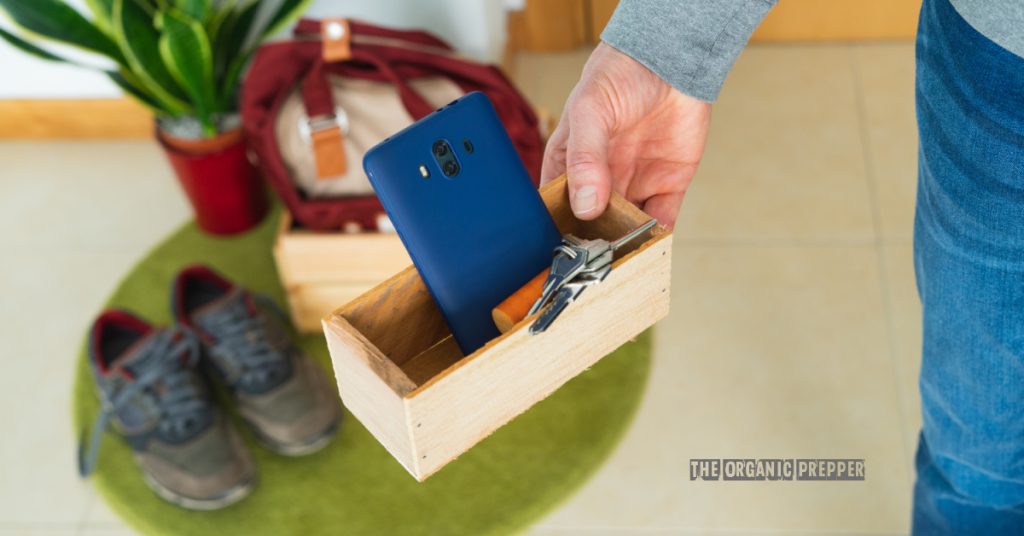
If you had to get the heck out of your house in a split second, how long would it take you to gather the most important things? I keep those things right by the door so that I can dash out of here fast in an emergency, and I’ve done so ever since I lived in wildfire country back in California.
- Bug-out bag – I keep one packed and in the entryway closet, on the shelf. It’s easy to get to and always ready to go. And nothing looks weird about a backpack in a closet.
- Important documents – I keep photocopies of these in my bug-out bag, a set in the cloud, and a folder with originals in the drawer of the table by the door. They’re in a fireproof document folder for an added layer of protection.
- Keys – If I’m at home, my keys are always on a hook by the door. ALWAYS. If I don’t make hanging up my keys an ingrained habit, they get lost and I have to waste time looking for them even when there’s no emergency.
- Sturdy shoes – We don’t wear outdoor shoes in the house in my family. I always have a pair of sturdy walking shoes by the door for emergencies. They have been equipped with orthotic insoles to accommodate the issues I have with my ankle. (This is the brand and type recommended by my physical therapist.) Extra socks are in my bug-out bag, so if I have to jam bare feet into the shoes, it’s only temporary.
- Flashlight – I always keep a flashlight right beside the door in case I need to go outside and see what’s going on. I started this habit when we lived in the Algonquin Forest – it was so incredibly dark there, far from civilization. The flashlight I keep by the door is the spotlight type. It was also handy if the dog needed to go outside in the middle of the night.
With these things by the door, I can leave fast if the situation calls for it. And it’s not just for natural disasters. These things are helpful for other types of emergencies, too. When I had to rush to the hospital for a family member one night, I grabbed my purse and my bug-out bag and had everything I needed to stay there overnight. I’m working on a hospital bag for myself because I’d much rather have a word search puzzle book than a water filter there.
In the kitchen
Did you know that most accidents at home happen in the kitchen? Statistically speaking, “Two-thirds of home fires start in the kitchen, 480 people die a year in kitchen fires, and 350,000 people are injured by kitchen knives each year. The most common injuries are burns, fires, and lacerations.”
I base my kitchen preps on these threats.
- Fire extinguisher – I always, always have a fire extinguisher in the kitchen. (At least one.) These aren’t extremely expensive, and they could save both your home and your life. I like this brand of fire extinguisher for its reasonable price and reliability. I keep one mounted in the cabinet beside the stove for fast access and a second one across the kitchen in case I can’t get to the first one due to the fire. When my daughter was 13, she had an unfortunate macaroni and cheese accident and used the fire extinguisher herself to deal with it. I believe these are vital additions to your home.
- Fire blankets – Another really useful addition to the kitchen that is in the cabinet beside the stove is a fire blanket. Some fires need to be smothered – and if someone catches a sleeve on fire or something, these could be urgently needed.
- First aid supplies – I keep a small stash of supplies to stop bleeding in my kitchen – you know, where all the sharp knives live. Under my sink, I have a little kit containing a packaged compression bandage, a tourniquet that can be used with one hand, and some everyday Band-Aids for little cuts. If I were to sustain a bad cut, my immediate need is to stop the bleeding. I don’t need my aftercare items like wash, ointments, and gauze to be in the kitchen because I’m probably not going to clean and dress the wound there.
The philosophy of where you keep your preps
Things that are life and death matters – something you need urgently and immediately – should be stored where you are the most 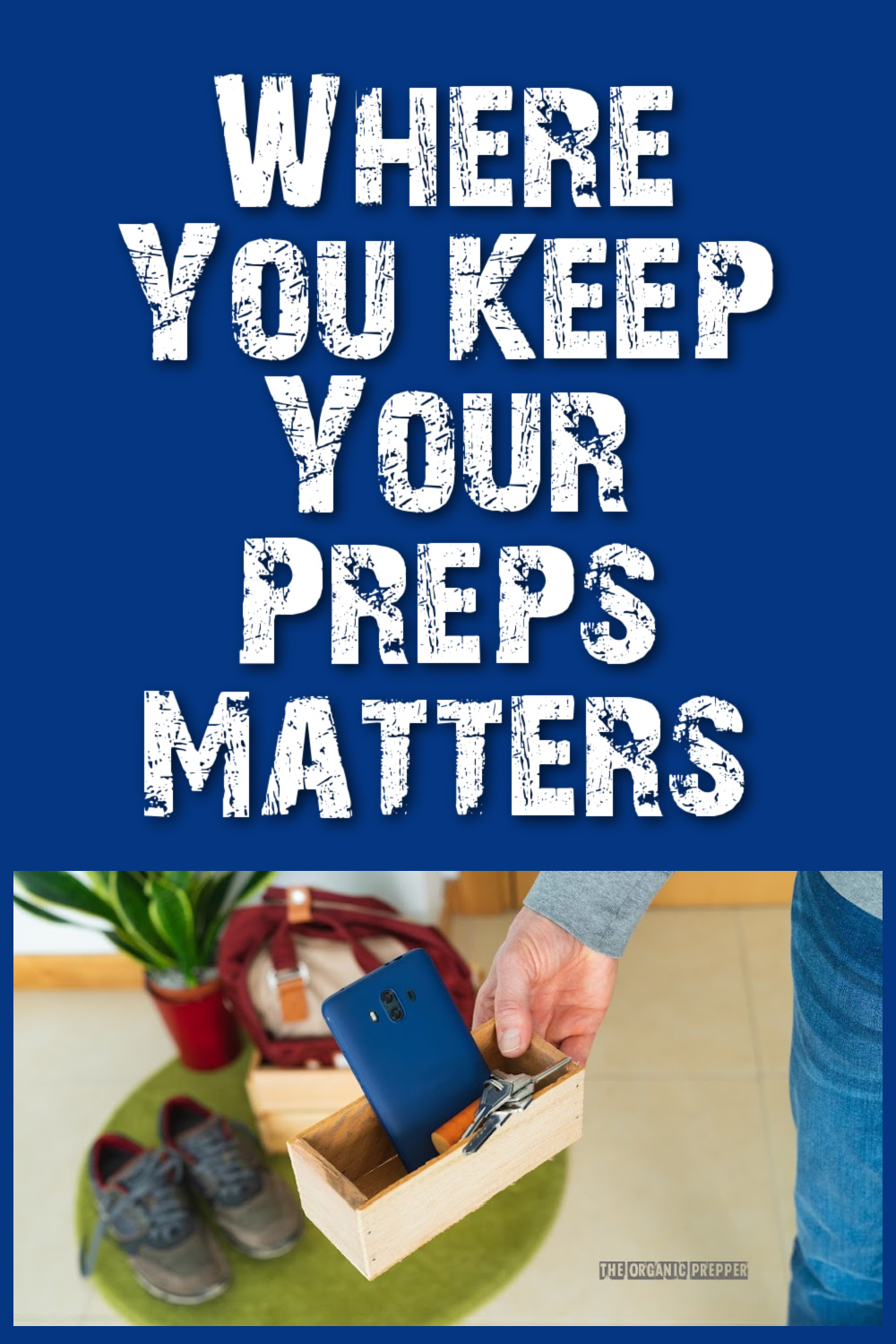 likely to need it. If you have a tractor, for example, you might want to keep a trauma kit in it. If you work on your car in your garage, you might require the same type of prep. If you have a workshop with a butane torch, you may want fire prevention items nearby.
You get the idea.
Having things close at hand can save you valuable seconds in a life-or-property-threatening scenario. It will only take a few minutes of your time to move everything into place, but when you need those items, you’ll be exceptionally glad you took the time to locate them conveniently.
So often, prepping isn’t about the huge expenses like a generator or a fancy new rifle. It’s about the little things, like having the things you need when and where you need them. Relocating a few supplies is something anyone, at any level, can do to be better prepared.
A story about preps being too far away
I used to work at an automotive repair shop at a car dealership. One day, by sheer dumb luck, I happened to be in the shop when a terrible crash sounded, echoing through the large room. The mechanics all dropped what they were doing and sprinted to the source of the crash, as did I. Shops are noisy but there are certain sounds that mean severe injuries or a very damaged vehicle.
This was no exception.
One of the techs, an experienced guy in his late 40s, stood quietly with his hand crushed between the body of a car and the hoist from which the car had slipped. (We later learned that the hoist had been faulty and it was not the fault of the technician.) He was pale and calm, and I recognized it as shock.
Before the techs could work together to lift the car off his hand, I yelled, “Wait!” I was a designated first responder at the dealership and had been to many training courses. I knew that with a crush injury, sometimes it hid the extent of the injury. I feared amputation and wanted to put a tourniquet on before the car was lifted.
The trouble was, my first aid gear was all the way across the shop, through a door, around a corner, and in my office. I had expected to be summoned to an accident, not to be there when it happened.
I sent someone running for my bag and made a makeshift tourniquet with a small wrench and a large shop rag. I applied it, and the car was lifted. It was far from ideal, but it worked well enough. 911 had been called, and real medics were not far away. The accident had not resulted in an amputation, but it was a terrible, career-ending wound. There was a lot of blood at the wound site, and when the man saw it, the remaining color drained from his face, and he dropped to the floor, taking me with him because I was holding onto that wrench for dear life.
The medics arrived and transported him to the hospital. I was perfectly calm until someone warned me to change my shirt. It was covered in blood, which I hadn’t noticed during the adrenaline dump of the accident, and suddenly I felt kind of faint and nauseated myself. It wasn’t from the blood exactly – that stuff has never bothered me. It was from the aftermath of all that adrenaline coursing through my body.
The first thing I did (after borrowing a clean shirt from a mechanic) was to order more trauma kits and set up stations on support beams throughout the shop. Never again would we have our essential supplies so far from an accident.
Where you keep your preps matters.
Do you have any little survival stations around your home and property? What kinds of things do you stash there? Where do you think it’s important to have a small stash of emergency supplies?
Let’s talk more about where to keep your preps in the comments section.









One Response
I just have to relate a prep that everyone has on hand, regardless of their finances. Pee. Yep, drinking your own urine will stop a peanut allergy reaction (ask me how I know) It can also stop the reaction from bee stings.
Your body puts the remedy into your blood 20 seconds or so after exposure and urine is mostly filtered blood plasma, so swishing about a tablespoon around in your mouth can stop the reaction. I haven’t had opportunity to test the bee sting yet, but I was sitting next to someone at a seminar who was eating a peanut protein bar and it triggered my allergy symptoms so I took myself off to the restroom with a paper cup and drank it down. I was completely recovered within 10 minutes.