
By the author of How to Prep When You’re Broke and The Tower
It was back in 2019 when I sold basically all of my stuff and took off to Europe with a one-way ticket. Every place I lived, I learned some frugal tricks that are commonplace in those areas.
Many people in Europe live with much less disposable income than we do in the United States. So they have a lot of interesting ways to save money, some of which you may wish to adapt to cut your own expenses. Here are five ways that Europeans save money.
Obviously, these tips are from the Europeans I met and are not representative of all Europeans.
Don’t have a dryer.
One of the requirements at the Airbnbs I booked was that they had to have in-unit laundry. I didn’t want to lug my dirty clothes around a strange city in search of a laundromat, then try to figure out how to use the machine with instructions in a language I couldn’t read.
Finding places with washers was easy. Finding a place with dryers? Nearly impossible. That’s because hardly anyone in Europe – at least the countries where I visited – uses dryers.
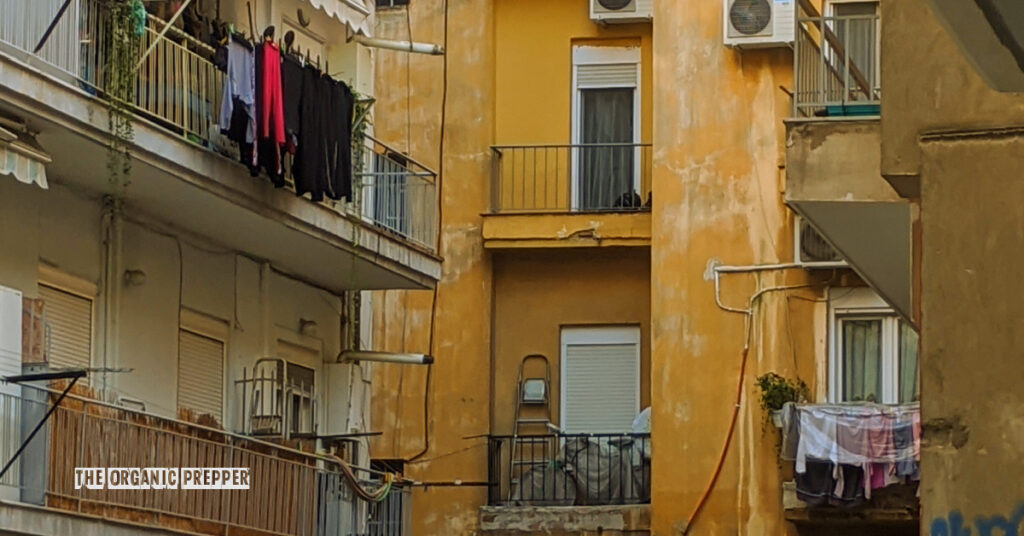
Most of the apartments I rented came equipped with a folding drying rack to put up for drying your clothes, while others had laundry lines. In fact, if you walk around residential areas in many European cities, clothing drying on lines like banners above the streets is ubiquitous.
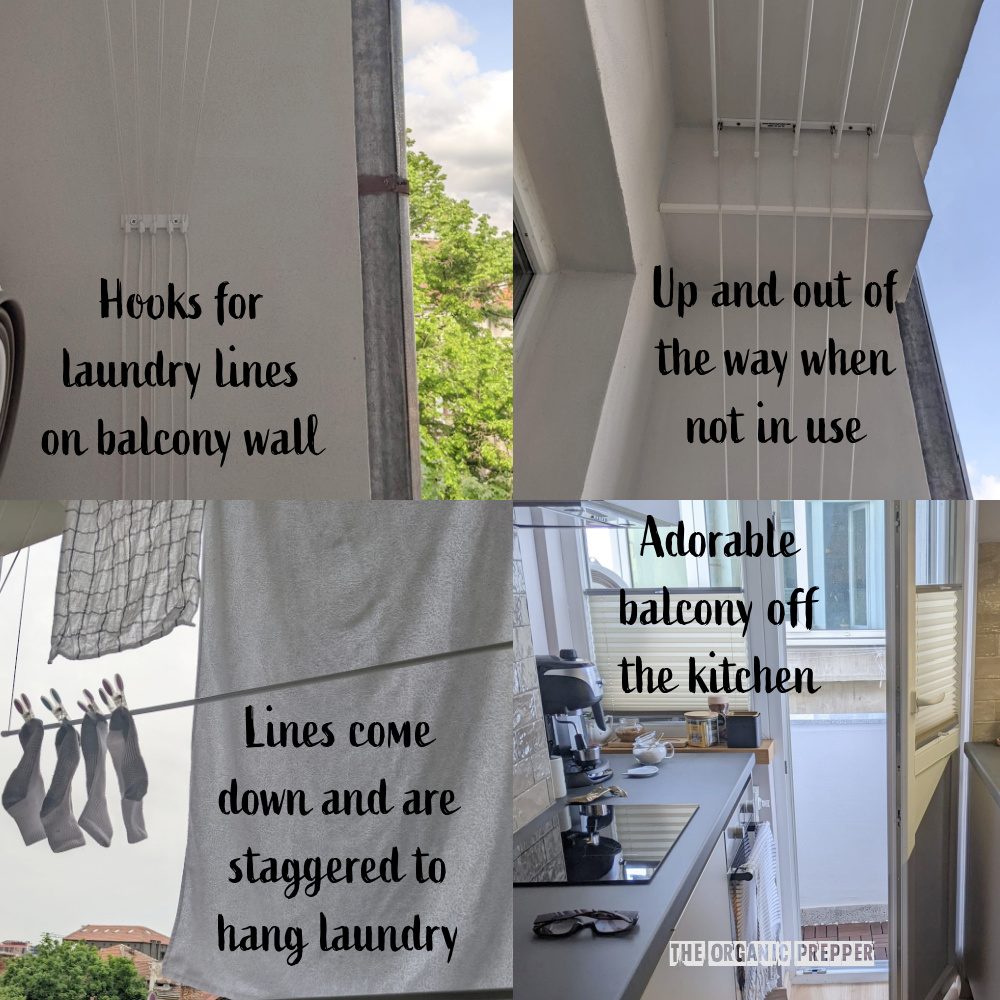
I had an especially great small-space drying set-up in Sofia, Bulgaria. There was a tiny little balcony off the kitchen, not even really big enough for a chair. But it had a set of 5 laundry lines that were slender metal rods. Each of the rods had its own pull and there were a series of hooks on the wall of the balcony. When not in use, the rods went all the way up to the ceiling, out of the way. When you had laundry, you just dropped the lines one at a time and staggered them at different heights so all the clothing got a breeze. I think that was a terrible explanation, so here are some photos I took.
You can save a fortune on your electric bill by not using a dryer, as well as saving on the cost of the dryer itself.
Some caveats: this is not ideal in certain circumstances. If you live in an area that is constantly damp, it takes a long time for laundry to dry, particularly indoors. If your home has a tendency toward moisture build-up, adding even more moisture to the air is a recipe for mold.
Only use your hot water heater when you need hot water.
One thing that took a little getting used to (okay, a lot of getting used to) was the fact that in many of the places I stayed, you only had hot water when you turned on the water heater. There was generally one that served both the kitchen and the bathroom, but I stayed in a few places that had a separate heater for each room.
These aren’t massive hot water heaters like the ones we use in the United States, but smaller ones. They take 15-30 minutes to fully heat up, so you have to plan ahead when you want to do your dishes or have a shower. After you’ve used your hot water, you flip off the switch. You’ll have a small amount of hot-to-warm water for the next few hours (sometimes up to 12) for quick handwashing. Once that runs out or cools off, the running water you use will be cold.
It sounds terribly inconvenient and it was, initially. But I got better at planning when I was going to have a shower. If I didn’t have hot water for dishes, I quickly boiled a pot of water to pour into the kitchen sink. I adapted.
Would this work in the US to save money? With the size of most hot water heaters here, it seems like you’d need a lot more time to heat the water in the heater, canceling out the benefits. But, if your water heater were to go kaput, it could be a strategy for when you replace it. (Plus the outlay would be far less.) In a perfect world, I’d probably go with an on-demand hot water heater if I were to make a change.
Go out for lunch or coffee instead of dinner.
Meeting up at restaurants is a huge part of the culture in many of the cities I visited. Athens, in particular, was absolutely studded with cafes, all with patio seating to enjoy the glorious Grecian climate. But having dinner is pretty expensive. I found that during the day, sidewalk cafes were absolutely jam-packed with people enjoying coffee together – you couldn’t find a table anywhere. Lunchtime was also busy (when prices are lower.)
Remember, frugality doesn’t mean you have to give up on everything fun. It means you have to prioritize and budget for the things that mean a lot to you. And if that means meeting up at cafes with your friends, then suggest having coffee or going out for dessert instead of for a full meal.
Use your dried bread.
I’d never heard of “rusks” before going to Europe. (Perhaps you have and I’m just sheltered.) Rusks are pieces of twice-baked bread that you can make once your bread becomes stale.
In Greece, rusks were often placed at the bottom of a dish and topped with soup or another hot food, which softened them up. They’re also placed at the bottom of a bowl of salad where they soak up the salad dressing. While I wasn’t really a fan, lots of folks really love it and find it a tasty way to end their meal.
You could easily take your cue from Europeans and twice-bake your stale bread after cutting it into sticks or cube form and use it like crackers or croutons. Not only does this make use of your stale bread that most people would throw out, it also spares you from needing to purchase croutons or crackers.
Of course, a major difference was the bread. Most people I knew would have been scandalized by the idea of purchasing a mass-produced, artificially soft loaf of bread from the grocery store. In fact, in a lot of countries, those packages are not labeled “bread.” They’re labeled “toast.” Bakery bread was far less expensive and about a thousand times better.
Walk everywhere.
When I lived in Europe, I didn’t have a vehicle. In larger cities like Athens, I used Uber sometimes if I needed to go from one side of the city to the other, but for the most part, it was me and my own two feet. The entire time I was in Montenegro, I rode in a car only one time other than entering and leaving the country. After three months of not being in a vehicle, it felt pretty weird when I was leaving to go to the airport.
This helped me in many ways. First, it got me outside every single day, rain or shine. When you live in a tiny apartment, even when you stock up on some food items, you still find yourself hitting the markets on a regular basis. I shopped for food daily throughout most of my stay – it’s nice to pick up your baguette, meat, and vegetables when they’re at their peak freshness.
The other great thing about it is fitness. When I first arrived in Europe I was hyperventilating up the hill to my beautiful Athens apartment. By the time I left many months later, I was carrying a 30-pound backpack full of food, bottled water, and wine up 435 stairs to my apartment in Montenegro. Yes, you read that right – 435 stairs – and I was no longer even slightly out of breath.
Walking saved me a fortune: no car payment, no car insurance, no repairs, no parking costs. And best of all, it made me a whole lot healthier without a pricey gym membership.
Walking for transportation isn’t an option for everyone. You may have a physical issue that prevents it or you might live too far away from the places you need to go to make it viable. But I certainly miss those days of exploring new places on foot.
Do you have any thrifty habits you learned from another country?
The time I spent traveling slowly throughout different parts in the world was educational and enriching in so many ways. I don’t have a single regret about going nomad when I had the chance. To this day, I use recipes I picked up elsewhere and strategies that I learned to make my life better.
Have you picked up any thrifty tips while traveling or living in a different country? Would you ever try any of these ideas? Please share your thoughts in the comments section.











3 Responses
Most of this is absolute crap.
And a lovely day to you, too, sir. 😂
Hi Daisy, I personally enjoyed the article. But, haters just live to poop on someone else’s sunshine. We can all recognize mental illness when we see it.
That said, my frugal hack at home is to grow and can my own food, and use my clothes line during the hot months. I do use my dryer during the winter and in chilly evenings so that I don’t have to use the furnace as much. When and if I renovate the master bath, I intend to put an on demand water heater in because we waste like 10 gal of water just getting the hot water from the heater to the shower. It has always irked me, and for a while I tried to catch it in a bucket, but that is such a hassle that no one would cooperate with that. All that potable water down the drain. Grrr…
In situations where you are on expensive municipal water, you can still collect water from a stream or rain/gutter for flushing and watering plants. I never understood people who got their water shut off for non payment when they could have saved themselves so much money with a couple of 5 gallon buckets of non potable water for certain purposes. In Michigan, there is a body of water in or near just about every town. I personally use rain water for all of my gardening and chicken tending needs. With so many used buckets on hand, I don’t run out often, and have to dump a lot before it freezes.
I have heard of Rusks, but didn’t remember that they were twice baked. Thanks for reminding me of that! I don’t eat much bread, so I don’t buy or bake it often, which is also a $ saver.