
By the author of How to Prep When You’re Broke and The Tower
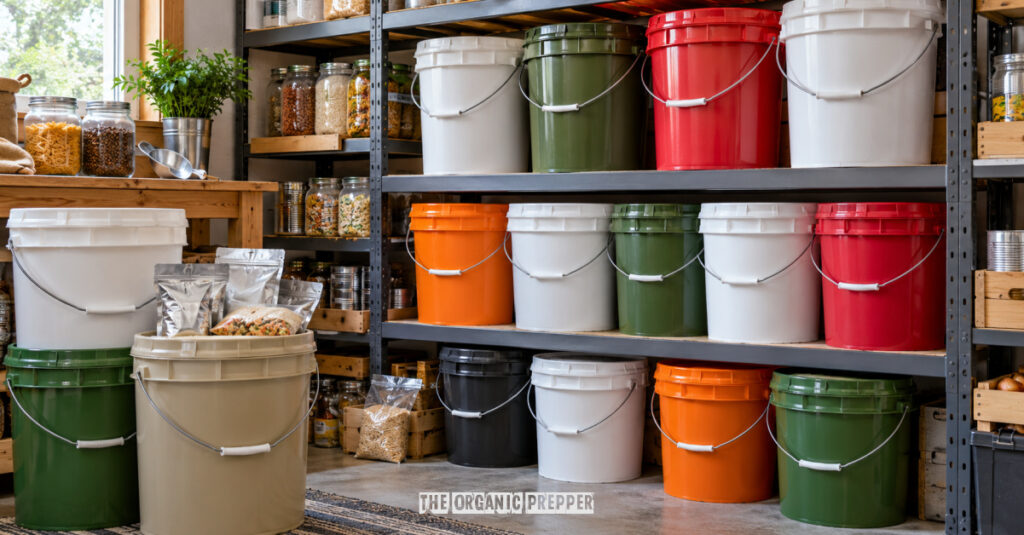
Are you in a hurry to build an emergency pantry? Emergency food buckets can be an essential part of a prepper’s pantry. Like everything else, there are pros and cons to stockpiling emergency food buckets.
Notice I didn’t say “the least expensive way” to build a prepper’s pantry. Buckets are definitely not the thriftiest way to create a stockpile. I also didn’t say “the healthiest way” to build a prepper’s pantry. There are all sorts of methods that will net you more nutritious foods.
Despite all of the drawbacks, I still recommend emergency food buckets. They have some unique benefits that can’t be overstated.
If you want to see my favorite emergency food picks, browse my recommendations. (I may earn from qualifying purchases.)
The pros
Please understand that emergency food buckets, while vital, should not be the entirety of your food storage or your everyday diet. They are only part of the picture of a perfect pantry.
That being said, here’s why every prepper should have some emergency food buckets stashed away:
Subscribe to our newsletter
Trying to figure out how to stock up while prices keep climbing? We can help with our free guide and newsletter!
- A lot of calories can be condensed into a very small amount of space.
- If you have the capability to boil water during an emergency, a filling meal can be yours.
- They add variety and speed to an emergency food supply.
- Calorie for calorie, they’re lightweight and easily portable in the event of a bug-out scenario.
- They’re professionally packaged to have a 25-year shelf life. It’s difficult to find any other food sources that will last this long.
- It’s super easy to buy buckets, stick them in the back of your closet, and forget about them until you need them.
- It’s fast. Place your order, don’t open anything, stash it away, and you’re done.
You can use emergency food not only as is, for a hot meal, but you can also combine it with other pantry items or leftovers to extend them far enough to feed a group. Don’t hesitate to get creative!
The cons
Now, the downside. When you’re going long-term, some compromises must be made.
- Emergency food buckets contain processed food.
- Emergency food buckets are much more expensive than purchasing things in bulk from the grocery store. (However, stuff from the grocery store won’t last 25 years.)
- They require a lot of water to rehydrate them. If water is a challenge in your location, this may not be the best idea for you.
- Many food buckets are extremely low in protein.
- Many food buckets are extremely low in fruits and veggies. Scurvy, anyone?
- The food is pretty bland. How much “risotto” and “pasta alfredo” do you intend to eat?
Emergency food buckets are definitely not health food and should not be your only source of stockpiled food.
How to prep with emergency food buckets.
If you look at the pros and cons and believe that emergency food buckets are something you want to add to your stockpile, here are some ways to maintain higher health standards.
Look for buckets that help you maintain your current diet. For example, these buckets are guaranteed to be gluten-free. If you currently eat low carb and high protein, pick buckets that contain only meat and only vegetables.
Save money by ordering in quantity. The more you buy, the cheaper it is per meal. Consider splitting a larger purchase with another family so that you both get a great deal.
Add other nutrients to your basic buckets. Consider stocking a variety of long-term freeze-dried foods, such as fruits and vegetables, meats, cheese powder, peanut butter powder, eggs, and milk.
Stockpile spices. You can dress up that bland pasta by adding your own special flavors. Cajun pasta alfredo, anyone?
Be sure to have a way to cook your emergency food. I have this stove, which can use three different kinds of fuel.
There are many brands of emergency food. Some are more expensive and some are less so. Flavors vary, as does quality. Some reputable brands to consider:
Additional things to know
Here are a few more tips.
Freeze-dried emergency food can be constipating. Be sure to stock up on a gentle laxative.
Add some vitamins. Be sure to have a high-quality multivitamin to cover what your diet may be missing. Bariatric vitamins give you a whole lot of nutritional bang for your buck.
Store them properly. Emergency food buckets should be stored in a cool dark place with low humidity for the longest possible shelf-life. This means that attics (too hot in the summer) and basements, if they’re damp, may not be the best choice for storage. When I had a finished dry basement, I felt that it was the ultimate storage spot for my buckets. Without those options, I line the back of a deep closet with them and hang clothes in front to obscure them from view.
Finally, try not to stress about all the details. Just do the best that you can. You’re still going to be far, far ahead of the game by having this supply.
What about you?
Do you stock some emergency food buckets for your long-term supplies? Why or why not? What is your favorite brand? Let’s talk buckets in the comments section.






3 Responses
Do you stock some emergency food buckets for your long-term supplies? Yes, my brother purchased a small supply of them for emergencies. You made excellents point concerning the pros and cons of emergency food buckets. Keep up the great writing.
I completely agree with this assessment. I have some Augason single ingredient items, and plan to get more. With the single ingredient items, you may have to repackage them into more useable quantities by vacuum sealing small portions so you don’t have to use everything once it is opened. Or, for your BOB, perhaps take some of the single ingredient items and combine into pouches to make portable soup that can be rehydrated easily. I have small packs of instant mashed potatoes, which can be combined with beef jerky and dried peas and instant rice, which will give you calories and protein, and you can vacuum seal that into small pouches for your go bag. That way you can control the salt, flavor, and quantity of each ingredient.
As a person who gardens and can preserve by pressure canning, my buckets are filled to the tippy top with canning lids. If you can make and maintain a hot fire, you can use a pressure canner if you know what you are doing. You control heat by raising and lowering the canner above the flame. I do have some freeze dried meals from 4 patriots, but honestly, some of what they have in their small kits sounds disgusting. Mango chili? If I am hungry enough…
I like to keep complete vegetable proteins which you can mix and match. Rice and corn, beans and whole wheat, barley and split pea. Mix and match, so you don’t need so much meat. I like lentils because they cook fast, even tho I don’t like the taste as much as beans. If I had a freeze dryer I could prepare my own freeze dried meals in flavors I like. For now, I will pressure can my own soup and sauce.
Yes I have a variety of meat, fruits and veggies in buckets and smaller amounts which come in bags but are also long term. When I started stockpiling I wanted some of each stage for eating, my food in the fridge will be eaten first, freezer next, the food I have canned then the freeze dried. I have a good variety and also as you said, herbs and spices to add some flavor when needed! I always be sure to read articles like yours to help me see if I’ve forgotten something. Thank you Daisy for a great article!