
Visit this article and others like it at our new website: The Frugalite
I have no idea why it took me so long to motivate myself to make laundry detergent. Never has getting things clean been so dirt cheap.
The thing that finally compelled me to stop being so lazy was the fact that…well..it was the lesser of two lazies. I ran out and my car is in the shop. It took far less energy to gather up the ingredients that I already had in my storage room than it would have taken to walk to the over-priced corner store and lug a heavy jug of it home up the great big hill that is my driveway.
There are lots of great things about making your own laundry detergent.
It’s very frugal.
The ingredients don’t cost much at all to make a gigantic batch. I checked online so that my prices were accurate, but I believe some of these items will be able to be purchased locally at a lower price. You can usually find all or most of the ingredients at Wal-Mart. If not, I’ve sourced them online for you. (Links at the end of the article.)
- Borax 20 Mule Team Detergent Booster, 76 Oz
$3.97
- Arm & Hammer Baking Soda, 64 Oz
$2.24
- Oxiclean Versatile Stain Remover, 5 Pounds
$9.47
- Arm & Hammer Super Washing Soda 55 oz $3.24
- Zote Laundry Soap Bar Pink 14.1 oz (Pack of 3)
– $8.75 (I know that it is closer to $1 a bar at Wal Mart but I couldn’t verify that online.)
- Fels Naptha Laundry Soap
$1.99
My price was about $20 for a huge tub of laundry soap – about 20 pounds of detergent. The instructions say to use 1-3 tablespoons per load. The amount I made will probably last our family for 6 months or longer, doing a load per day. My best guess is about 250 loads – I’m going to keep track of it. If that is the case, we’re looking at about about 8 cents per load of laundry.
It’s incredibly easy.
I’m kicking myself for not making this before – it is incredibly easy! The thing that took the longest was chopping up the soap. If you had to use a hand grater for the soap, you might want to sit down at the table and turn something interesting on Netflix, because that would definitely take a while. I used the dry container for my Vitamix and it took about 10-15 minutes to chop up all of the soap. Aside from that, it was a matter of tearing the boxes of the individual ingredients open, dumping them into a tub, and stirring.
I combined two different recipes and techniques for my laundry detergent. You can find them HERE and HERE.
You can adjust the recipe for allergies and sensitivities.
If you have a family member with sensitive skin or allergies, you can easily adjust this recipe. Several recipes I found online did not contain the Oxy-clean, for example. You could also choose different soap and use Ivory or Castile soap.
Whatever your needs, when you make the item yourself, you can switch things around until it is perfect for your family.
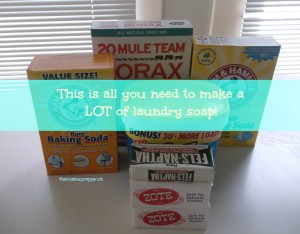
This is what you need:
- 76 oz box of Borax
- 5 lb container of Oxy-clean
- 55 oz box washing soda
- 64 oz box of baking soda
- 3 bars of laundry soap
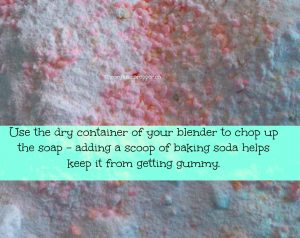
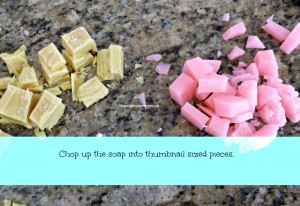
Cut the soap into pieces about the size of your thumbnail. Initially, I was using the dry canister of my blender for just the soap but it was getting gummy instead of coarsely chopped. I resolved this by adding a half cup of baking soda and handful of cut up soap and processing the two items together.
Don’t over blend it, or it will still give you gummy chunks.
The Zote soap is much moister than the Fels Naptha, and in the future, I’ll most likely stick with the Fels because it chops into a nice powder. Another lovely-smelling and natural option would be Dr. Bronner’s Castile soap.
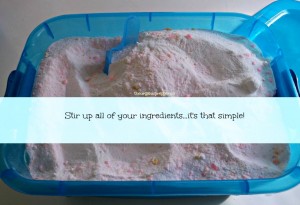
Then comes the ridiculously easy part. Dump all of your ingredients into a container big enough to mix it in – I used a large Rubbermaid tub and two big cooking spoons. Once it is well mixed, transfer it into the container in which you intend to store it.
Instructions for use:
I saved the scoop from the Oxyclean container. Half of the scoop is 3 tablespoons, which is more than enough soap per load. With powdered laundry detergent, some people prefer to fill the washing machine and agitate the soap for a few minutes to dissolve it. I just chucked it in on top of the clothes, started the machine and walked away, and it dissolved fine. This is dependent on the hardness of your water, so you’ll need to experiment for best results.
Resources:
(These are affiliate links. The FCC wants me to let you know that I get a small commission if you choose to purchase these items from Amazon. This does not cost you anything additional, but it does help support the operating costs of this website.)
Vitamix 1300 TurboBlend 4500
Borax 20 Mule Team Detergent Booster, 76 Oz
Arm & Hammer Baking Soda, 64 Oz
Oxiclean Versatile Stain Remover, 5 Pounds
Church & Dwight Co 03020 Arm & Hammer Super Washing Soda 55 oz.















30 Responses
Hi Daisy,
I have been making my own laundry soap for more than several years now but I make mine into liquid and only use Borax, Washing Soda and the Fels Naptha. It makes 10 gallons and does a great job. I grate my bar of soap the old fashioned way by grating it on a cheese grater over a plate. The kind that can stand alone if you stood it up. This would be a great alternative if there was no power.
It makes 5 gallons at first but you fill old laundry soap bottles half full and the rest with water per the instructions so you end up with 10. I have been considering making a powder version so I do not have to keep the heavy 5 gallon bucket in the closet and refill my bottles when they run out. Plus, I would not have to use more of my precious water supply or heat it in a SHTF scenario. I probably will not use quite as many ingredients as you though to save money and since these three have been working for me for so long.
Also, my daughter has eczema and has not had any outbreaks since using this recipe. Thanks for the food for thought.
White vinegar = fabric softener that is better than the smelly stuff from the store. We buy 50% vinegar (acetic acid) and cut it with water. Do not eat this stuff as it is a by product of the oil industry. You can buy 20% vinegar which is made by re-fermenting ethyl alcohol. It is a safe food source. Just cut either one to 5% and add to the fabric softener dispenser. When you quit fabric softner, the mold quits growing in your washing machine.
I haven’t used liquid fabric softener in the washer in years – just a cheap softener sheet in the dryer. With each load of clothes washed, I add approx. 1/2 cup of household/kitchen white vinegar (5%) and it cuts down on the funk in the washing machine as well as acting as a disinfectant to the washed clothes! And as if it needs sayin’, do NOT use red wine or apple cider vinegar!!
Quick note: not cloth diaper safe. But Google can point you to several good ones.
I make mine with one box Borax
one box washing soda
one box (2 lbs) baking soda
and two bars fels naphtha grated.
It costs me about $10.00, and lasts about six months.
Don’t be afraid to shop for these items at your local Dollar Store.
The packages may be smaller – ’cause everything in the store costs only $1 – but the cost per ounce may be less expensive than even Wal-Mart!
I grate my Fels Naptha on an old grater picked up at a yard sale. It is easy to grate, and only takes 3-4 minutes. I make the liquid, and grating it fine helps it melt very quickly.
Does this soap work in a HE machine?
According to the other sources that I sort of melded together, yes, it works in HE machines. I don’t have a High Efficiency – just a regular machine, so I can’t verify this from my own experience.
Well, when times get REALLY tough, it’s made with hardwood ashes, soft water, and animal fats…
I also use homemade laundry detergent. It works great and lasts a LONG time. It is a low sudsing formula and gets the clothes clean.
The directions I found online suggested to add the homemade laundry detergent directly to the clothes in the washer barrel for a HE washer. Since I have a HE washer, that is what I do.
Yes! I’ve been using a home-made version for over 8 months now with no problems.
I have an HE machine and have used many homemade laundry recipes with no problems. They are mostly organic and leave no residue. Just use a vinegar and water “fabric softener” in your rinse cycle. You will be amazed at how clean and soft your laundry will be.
I use older baking soda from the pantry to make laundry detergent and buy new to replace stock.
2lb. box of baking soda = 3 cups
No gum up the blender solution
We make our own soap using the same ingredients. We grate the bars on a cheap grater and let the gratings dry out in the open air for a couple days. Then use the blender to powder it up. No gummy mess in the blender. We then mix the rest of the ingredients with a paint stirrer on a drill in a five gallon bucket. Then package up the the ingredients in a nice decorative jar. We use it dry, 2 tablespoons to a full load. Works absolutely great. Some folks like to make a liquid but it gets to viscous (snot like) over time. The powder works real fine without the mess. Note: If you are going to use the blender for the bar soap after it’s dry, do it outside in a breeze. The stuff is very irritating to the throat and nose and the dust will take flight when you open the blender lid.
I have been making my own laundry detergent for several years. I have been using the Fels Naphta soap but read online it’s a petroleum based product. I also bought some Zote but after reading online it can gum up your washing machine I’m leary of trying it. I think next time I make a batch I may use some kirk’s castile, ivory or goats milk soap instead. I also use vinegar in the fabric softener dispensar. No our clothes don’t smell like vinegar. I use a Cuisinart mini prep food processor to process the soap bars.
These are great, simple alternatives for those who cannot use regular laundry detergent. We do a lot of laundry in my family, and the cost really starts to add up. This is a great way to save extra money! Thanks for sharing!
Daisy, that recipe is way overkill and too expensive. Here’s the cheap way out:
1/2 c. Boraxo
1/2 c. A&H washing powder
1/2 bar Ivory (or any) soap
1 pot of water
1. Start boiling the water, and while it heats up, grate 1/2 bar of soap with a cheese grater. Add soap and reduce heat to just below boiling temp.
2. When the grated soap is dissolved, add the Borax & Washing Powder. Stir until dissolved.
3. Pour half the liquid in one empty, gallon sized, laundry detergent container and the other half in another.
4. Fill both to the top with cold or warm water.
Cost = pennies
Time = about 15 minutes
Even cheaper — save your soap slivers and grate them for the laundry detergent.
Actually I save them right now. I grate them, add to a pot of water, blend or process some oatmeal, add a small amount of vanilla or other fragrant oil/extract, and then spread out in a foil or parchment lined baking sheet and after a couple days, score them for bars. Then let dry longer until they’re hard as you prefer. Last time I did this was a few years back and the result lasted me about 5 years (hubby wouldn’t use, was too “girly” for him).
Nice recipe. Thanks!
After reviewing the ingredients list of Fels-Naptha bars, how on Earth does it keep showing up in “natural” recipes for homemade alternatives!? It doesn’t sound like it is any better than the big name brand crud you’d normally buy.
I am wanting to use my laundry grey water for the lawn. Is there a substitute for Borax?
My understanding is that anything with Bor in it is poisonous to plant life.
My method for easily getting a fine grain: Using the grater wheel WITH the chopping blade simultaneously! Put some of the powders in the bowl to help mix easier, then as you feed the soap into the top of the machine to grate it, it falls into the bowl and chops into a fine grain, mixing with the powders. I’m not sure if all food processors are set so that you could use both the grater and the chopper simultaneously, but my cheap one does. 🙂
Ohhh….I’ll see if I can make mine do that. 🙂
Although I’m optimistic about trying this myself, I must say that the article write-up isn’t very good and that is casting some pretty serious doubts on this project.
I tallied up the total cost of all the ingredients listed, and came up with a price of $29.66 not including taxes or shipping costs, which is a SUBSTANTIALLY higher number than the $20 quoted in the article, and is either a typo, miscalculation, or in my case, misleading considering I was linked here by a DIY page specifically trumpeting a sub-$20 price point for this. At $30 plus the extra effort, I’d be better off sticking with generic pre-made laundry detergent, being that I’m unconcerned with skin sensitivity/chemicals/etc.
Next, the article was vague about what ratio of Zote to Felds-Naptha we are supposed to use. Going by the picture (2 Zote bars and 1 Felds-Naptha bar)I’m going to have to assume it’s a 2:1 ratio. But, has anyone been able to determine whether a formula made of 3 bars of Zote and no Felds-Naptha, or conversely, 3 bars of Felds-Naptha and no Zote, is better than the other at cleaning, or can best results only be achieved by mixing them?
—-
NOTE: I can confirm that Zote is $.97 per bar at Wal-mart, as is the Felds-Naptha. However, it should be known that Dollar Tree and other $0.99 stores can/will sell individual bars of either for $0.67 or less, cutting out a very substantial amount of cost compared what’s listed in the article and bringing the price down to a far more manageable $20.93 which is much closer to the $20 price-tag, assuming all other ingredients are the same. I’m going to do some more hunting for even cheaper ingredients, which could bring it down to below $20.
Dear M: Sorry that you were unhappy with the article. At the time of publication the prices were accurate. Of course, prices do go up over the years, so it’s only reasonable that these prices did as well.
Thanks for you input!
Daisy
Hi Daisy, I am just meeting you for the first time. It sounds like we could have a fine time together! We are just north of you in Oregon, near Eugene.
I have been making my own soap for almost 20 years, from fats I recycle, just like folks did way back when. Fat from beef, chicken, turkey, venison, pork, lamb, old olive oil based herbal salves and oils I have made, our married son’s bacon grease, I have used them all. Every recipe is different! Recently I started adding 20% coconut oil because it makes a good lather they say, even in cold sea water! I add no scent(expensive and takes a lot).
This has been amazing for our skin, I am guessing because the glycerin is not taken out like in the commercial soap making process (so they can sell it for cosmetics and hand lotion, etc.) and our daughters will not travel without a bar for treating stains in their clothes!
These were wonderful discoveries for me. My husband even got tomato soup out of his expensive, white, rhinestone covered western shirt, that got splashed all down his front at a retirement home we were entertaining at!!
Amazing, a skunk got our dog last night so I had my husband wash his skunky hands with my bar soap and hot water. There was absolutely no smell left on his hands!!
When making soap, there are a lot of trimmings after you cut the bars so I let it dry for quite awhile and then hand grate for using in the washing machine.
My only expenses? Powdered lye from the hardware store…several dollars/lb. and if you choose to add the coconut oil, which I have only done twice.
We buy and grow organic meats so I feel much better about my starting ingredients.
Soap making is fun! Every prepper should try it!
PS, 6 important things I have learned the hard way:
1. Have your fats and lye water at the same temperature when you add them together or they will curdle. I had to heat the mess up again and I got what I called rustic soap, all lumpy on top. It sold well for Christmas, with red raffia tied around it!!
2. Always use an online lye calculator, I like Brambleberry, to plug in all the amounts of your various fats and oils.
3. Test the pH to make sure you do not use the soap before it will not burn your skin anymore, somewhere around a pH of 8-9. I get the pH paper from a pharmacy or Costco, wet the curing soap and pH paper and rub together. Compare the color to the chart that comes with the pH paper. It always takes at least 6 weeks to reach a safe pH.
4. Don’t let kids or pets touch the curing bars and for that matter, keep them away from the soap making process completely.
5. Always keep vinegar (any cheap kind) ready to neutralize any lye or new soap that gets on your skin or clothes…I wear a plastic apron and cover the table with brown paper bags which I burn afterwards. Goggles is a good idea too. Once a batch failed and I added vinegar until it tested neutral and then put the mess on the compost pile. Before neutralizing the lye, it would have been dangerous to animals and plants! (It helps that I have a degree in Chemistry!)
6. I always mix the lye in the water outside, to avoid the resultant caustic fumes, and stir until the lye crystals are completely dissolved. Once I didn’t stir and it formed a hard cake of lye in the bottom of the water, which of course will not mix in!!
Happy soap making!
Found your site from Gaye @ Backdoor Survival.
Have question on the homemade laundry soap. I am getting a new High Efficiency washer and dryer set(DH wanted a first floor laundry room and decided to replace the old washer and dryer as well) and I would like to know how the soap does in those machines? I really don’t want to “gum” it up
What some people do when they have those machines is turn this powder into a liquid. Add 1 cup of this to a gallon of very hot water – shake or stir well until it is combined. Shake each time before using and use about half a cup of your liquid per load. Every once in a while, run a gallon of white vinegar through a short wash cycle to keep things nice and clean. 🙂
I have been making my own laundry detergent for years. I use Ivory soap bars. I found a way to grate the bars easily. When I am done making a batch I unwrap the next six bars of soap. This gives them plenty of time to dry out. I use the grater on my food processor for the soap bars. Then i switch to the mixing tool and process the grated soap, borax, washing soda, and baking soda. This makes a fine powder.
I have used this diy detergent in my HE washer without any problems.
Question: are there any DIY formulas for making laundry detergent that works in cold water?
From what I’m reading, laundry in cold water lets clothes last longer and uses much less water than the traditional hot water in a machine system. In SHTF circumstances, power or fuel to heat water might be a bit scarce … and the ability to wash clothes in cold might have additional benefits.
If one is traveling, whether RVing or other-vehicle mobiling, when hot water might be a problem, again the ability to do laundry in much less cold water could be a plus.
So far, the only readily available cold-water compatible liquid laundry detergent I know of (and I’m no expert at all on this) is the ALL product from the Henkel Corporation (https://www.all-laundry.com/) that’s readily available from Wally World. It even works well with manual mobile washers — the kind that you use your muscle to repeatedly plunge into a 5-gallon bucket of water with such detergent and dirty clothes — a useful skill for scarce water situations including SHTF, travel or camping cases.
So back to my question: does anyone know of a DIY method of making a cold-water compatible laundry detergent?
–Lewis