By the author of Be Ready for Anything and How to Prep When You’re Broke
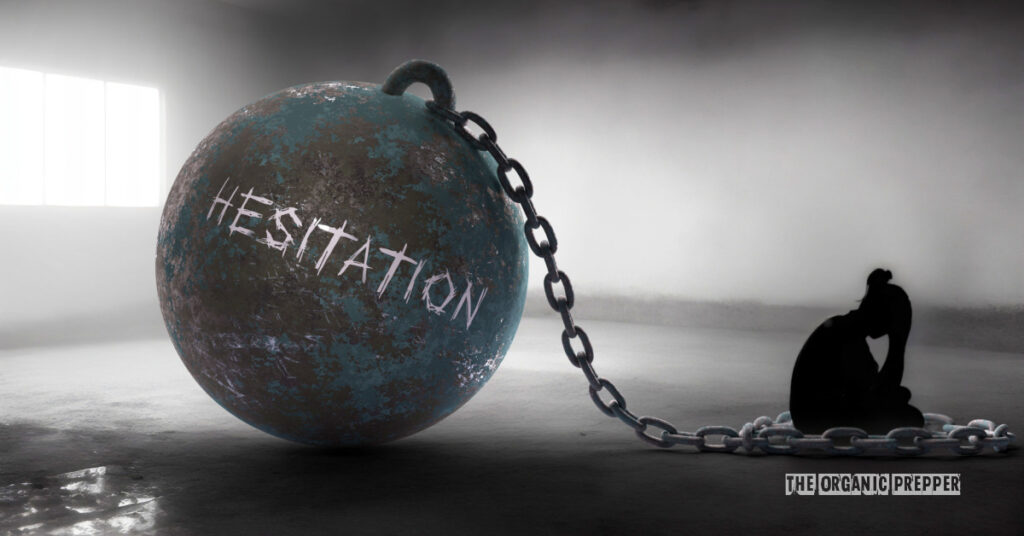
Preparedness isn’t just about the supplies you stockpile and the skills you learn. It’s about psychology too. And an important step toward survival is understanding the psychology behind hesitation.
In a worst-case scenario, hesitation kills.
He who hesitates is lost. Swift and resolute action leads to success. Self-doubt is a prelude to disaster.
~Joseph Addison
It’s simple psychology that no one wants to accept that something horrible has happened.
The human brain is configured in a way that it is in our very nature to deny that something outside our normal paradigm has occurred. This is called cognitive dissonance.
“Cognitive dissonance is the feeling of discomfort when simultaneously holding two or more conflicting cognitions: ideas, beliefs, values or emotional reactions…Dissonance is aroused when people are confronted with information that is inconsistent with their beliefs. If the dissonance is not reduced by changing one’s belief, the dissonance can result in restoring consonance through misperception, rejection or refutation of the information, seeking support from others who share the beliefs, and attempting to persuade others.” (source)
In a crisis situation, denial can be deadly.
These are the phases of psychological reactions in a crisis:
- Denial – People do not want to believe the event occurred or is occurring. They simply cannot accept, for example, that a plane just deliberately crashed into the building where they are working.
- Delay – People often opt to do something to delay the acceptance of what is going on. They might tidy up, put away food in the refrigerator, or methodically gather belongings to give themselves another few moments of perceived normalcy.
- Diagnosis – People then begin to assess the situation. They begin to consider the input from their senses: the smell of something burning, the sound of something crashing down or people screaming, the sight of the devastation.
- Acceptance – People then accept that this crisis is indeed occurring.
- Consideration– At this point, most people begin to consider their best course of action. Others are so overwhelmed by the situation that they shut down and have to be aided by first responders or other victims of the crisis in order to survive.
- Action – Finally, a course of action is chosen and implemented. Some examples of this could be escape, evacuation, fighting back, performing first aid on injured people, or fortifying their position.
Some real-life examples of psychology at work.
Interviews with people who escaped the World Trade Center after the 9/11 disaster, those who survived plane crashes, and others who lived through fires, all describe how they instantly froze when the devastating incidents occurred. Despite the fact that their very lives were at risk, structures were crumbling, or they were the victim of people who were intent on harming them, they could not immediately accept that the event was occurring.
Many people talked about gathering up documents or personal belongings before heading for the stairwells on 9/11. People in plane crashes often grab their carry-on bags, despite flight attendants’ warnings to leave them behind. People in house fires will often try to grab photo albums or possessions before escaping the building. The response is very common, and it is a function of a brain that doesn’t want to accept the dreadful reality: people busy themselves with things which are mundane in an attempt to delay accepting the current situation.
Subscribe to our newsletter
Trying to figure out how to stock up while prices keep climbing? We can help with our free guide and newsletter!
While these stories are from survivors who did manage to escape with their lives, there are likely many others who did not live because their brains simply refused to accept that something so horrible could be occurring. I learned about this (and many more examples) from the book The Unthinkable, which I highly recommend.
These are the most common reactions.
Dr. A. R. Roberts performed a psychological study in 2000, which he reported on in his Crisis Intervention Handbook. Roberts noted these common reactions in the midst of a crisis:
- People first begin to recognize that there is a threat.
- Next, these individuals discover that the stress and trauma of the event cannot be dealt with using existing coping skills.
- People then begin to experience fear, confusion, and stress.
- Those facing a crisis begin to exhibit symptoms of distress and discomfort.
- Finally, people enter a state of imbalance where the crisis situation seems insurmountable.(source)
During military training, recruits are put into situations that train them to immediately assess a situation and instantly choose a course of action. This allows them to act more quickly than other people, and it gives them an advantage in many scenarios.
The key, though, is not just to simply act as soon as an event occurs. It is to speed up your actual decision-making process. One way to do that is by skipping the cognitive-dissonance phase. You must go through the above reactions quickly or not at all in order to respond quickly.
If you can immediately accept that something out of the ordinary has occurred, you will be able to move on to the assessment phase instead of wasting precious reaction time convincing yourself that the event itself has occurred.
You can improve your reaction to a crisis.
Speeding up your reaction to unexpected circumstances is a two-fold process. It is both physical and mental.
Think about an athlete. If you throw a ball, even unexpectedly, his immediate reaction is to put up his hand and catch the ball before it hits him in the face. His muscle memory has kicked in, and this is his automatic response. A non-athlete might react differently. He might stand there and get hit with the ball or put up his arm to block the ball, but his first reaction might not be to try to catch it.
The athlete has spent many hours catching and throwing, so his body is already prepared to do that in a split second. As well, sports like boxing or martial arts hone your reflexes and teach your muscles to instantly respond in a certain way. When police officers and members of the military are undergoing training, they spend many hours at the shooting range to make their weapons an automatic extension of their arms.
Training isn’t just for professional first responders. Doing so can speed up your reactions, both physical and mental. It may not turn you into a ninja, but it can definitely improve your chances of survival.
Here are some ways to keep your physical reflexes sharp (or to improve them if they are a bit rusty):
- Use it or lose it. If you have a desk job, you may not spend enough time being active. Take some time every day to toss around a ball, to go to the gym, to hike, or to go for a run.
- Learn to fight. Martial arts, boxing, krav maga: all of these are great exercise and great training.
- Perform a balancing act. Little kids love to walk on curbs, blocks of concrete, or anything else that can serve as an impromptu balance beam. It’s an important part of their development. As adults, most of us spend little time practicing our balance. Try walking on the curbs right along with your kids, climbing, or going to yoga. Help your body remember what it is to use balance.
- Cardio. In the event of an emergency, you don’t want to be huffing and puffing after you’ve gone down two flights of stairs. Get your heart in shape and keep it that way with regular cardiovascular exercise that gets your heart rate up.
- Practice, practice, practice. You can create muscle memory by repeating something over and over until it becomes as natural to you as breathing. Go to the range and practice shooting your weapon. Practice archery. Play catch. Do agility drills. All of these things prepare your body to respond instinctively in an emergency, which can shave precious seconds off of your response time.
- Don’t let being disabled rule all these things out for you. If you, like me, suffer from a chronic illness or condition that has caused you to be disabled, what items above can you adapt to your situation? I can still shoot. I can walk short distances. I can work on my balance and my strength – it just might look different for me than it used to.
You can improve your mental responses, too.
Equally important, if not more so, is improving your mental response to a crisis. As was discussed above, people tend to squander time dilly-dallying over the acceptance of the fact that the event is actually occurring. If you’re reading this article, more than likely it is because you have already mentally accepted the fact that sudden emergencies occur, and that puts you one step ahead.
- Run scenarios. No one can be mentally prepared for everything, but by imagining situations in which a crisis occurs, you can train your brain to look for solutions. You will have already overcome a portion of that cognitive dissonance that says “This can’t be happening to me.” My kids and I do this when watching movies. Sometimes we stop the movie and discuss what we could do if a similar incident happened to us. They’ve taken it a step further and sometimes bring up a scenario when we are out. We run through our options and talk about the pros and cons of a course of action.
- Don’t live in a bubble. Be aware of trends in the news. For example, back in 2014, there was a spate of horrific attacks across the country called “knock-out” attacks. In this so-called “game”, a group of teens, for sheer amusement, brutally assaulted an innocent victim. If you know that this something going on in your area, you can sometimes recognize the situation immediately and pass that moment of cognitive dissonance. This allows you to respond and defend yourself quickly and decisively.
- Be aware of your surroundings. If you are glued to your iPhone or otherwise oblivious to that which is going on around you, then it’s going to take you longer to assess the crisis. Actually, it’s going to take you longer to realize the crisis is even going on. A person who practices situational awareness will often observe unusual behavior and be in response mode before the crisis is fully developed. For example, they might notice suspicious behavior from another patron in the store before that patron whips out a gun and tries to rob the clerk. This would give the observer a distinct advantage because they’d already be moving on to the consideration step in the crisis process while everyone else in the store was still on Step 1, denying that they had found themselves in the middle of a hold-up.
- Practice blocking out distractions. At my Krav Maga class, the instructor likes to add some distraction to the scenarios. Loud music and strobe lights are regular additions to drills. You can’t hear, it’s hard to see, but you still have to focus on your opponent.
Know the psychology so you can sidestep the unhelpful steps your brain wants to take.
By understanding the natural human responses to crises, we can cut our personal reaction times.
Hopefully, you are never in a 9/11-style attack, present at a convenience store robbery, or caught in a natural disaster, but if you are, your ability to accept the situation, think quickly, and take action could save your life and the lives of your loved ones.
Do you have any other suggestions to improve a person’s response time in an emergency? Do you have any examples of how this has worked well in your own life?
Let’s discuss it in the comments section.







7 Responses
This is such an important article.
Now that you’ve described it, this natural human tendency to avoid facing the unthinkable is easy to recognize. For myself, having this awareness ahead of time will help me move through that stage more quickly.
Thank you, Daisy!
Very good message…every good point
As I reflect back on the disaster that was Hurricane Helene, I realize that I sat in denial ahead of the actual crisis. I had gone to bed the night before concerned for my brother who lives just north of Atlanta. The remnants of the hurricane were predicted to hit that area hard. I awoke at around 5am to the worst storm that I could have ever imagined. The rain was pounding down. The wind was blowing hard. The thunder was clapping all around. It was close and incredibly loud. How could I be so brainless at a time like that? But I was.
Who could have known that tornadoes were embedded in that terrible storm? To me, tornadoes only occurred in the flatlands but I was safe and snug in the ancient Blue Ridge Mountains.
Then suddenly Whump, thump, crack, crash; the trees came smashing down on the house. I jumped up and hurried to my eldest son in the next bedroom. He was visibly shaken. A large poplar had fallen the entire length of the house, just 3 feet from the head of his bed. Had it been just a couple of feet closer, it would have taken down the back wall of the house and killed him. That was the Whump. Thankfully, poplars are practically all trunk so the top with the branches came down on the other side of the house causing little damage. But next came the Thump. A huge oak slowly uprooted from the soaked shallow ground and came crashing down on the center of the house, bringing two other trees with it, cracking the trusses of the roof.
Needless to say that by then I was on full alert. Rain was pouring in through the living room ceiling but I was fast to act, laying down towels, lining up empty wastebaskets (which quickly filled,) and protecting the furniture with blankets.
Then suddenly it was over. The rain stopped and the sky cleared but the house remained dark, covered completely side to side and end to end, draped by the branches of that old oak tree. There was no electricity, no running water (because the well pump runs on electricity,) no phone, and of course no internet. The windows wouldn’t open due to the pressure from the weight on the roof. The roads were blocked with fallen trees and downed power lines.
Later in the day my daughter and son-in-law appeared. It had taken them 45 minutes of zig zagging through back roads and flood waters to almost make the 15 minute trip to my house, then hiking in the last quarter mile. The next day they returned with in-laws and cousins armed with chainsaws. They got the trees out of the road and took as many branches off that oak tree as possible. It ultimately took a crane to lift the trunk from the roof.
It has taken a long time to recover, well not quite. 20 feet of the oak trunk and five others still lean over the side yard. A dozen other trees lie uprooted in the woods. The remains of the old chimney rest in the rhododendrons. And when I look through the back woods I can see that my neighbor’s house, which had to be razed to the ground, is being rebuilt. 4 other houses that I can see from my deck are still covered with tarps, 3 are vacant. The road across the dam was nearly washed out and remains one lane only.
But here is the big what-if. What if the power had never come back on? What if communications had never been restored. What if the insurance companies had not paid for restoration of damaged houses? And what if things had never returned to “normal?” What then? This is why we prepare. Life is unpredictable — very unpredictable.
Wow – it sounds absolutely terrifying. I’m so glad that things worked out for you.
I forgot to add the brainless part. I just sat on the edge of the bed waiting for the storm to pass. Hoping, praying that it would all be over soon. We should have headed to the basement. Hindsight is always 20 20.
I think we’ve been conditioned not to listen to our gut instinct that the good Lord gave us!
In example, I was talking to a friend about the videos on YT with women talking about near kidnapping events. She explained she was feeling uncomfortable when leaving a store just prior to our conversation, when it appeared two men zoned in on her and very clearly moved closer to her.
In her immediate thoughts she didn’t want to seem silly!! NO! And so what if you are!! It can save your life! They were up to no good and her gut told her they were ahead of time! She didn’t want to be overly paranoid or make a scene unnecessarily. I’m sorry but in this day when people are afraid of offending one another….offend!! And they won’t be offended if they’re good solid people that weren’t up to nefariousness!
STOP LOOKING AT AND BEING ON YOUR PHONE IN PUBLIC AND LISTEN TO WHAT YOUR BODY IS TELLING YOU! SCREAM, YELL, DRAW ATTENTION TO YOURSELF!
I carry mace and/or a hand held stun gun EVERYWHERE. Even with my husband with me. Call me paranoid I don’t care! I’m keeping myself and loved ones safe if I can and forget feelings that might be hurt if you misunderstood someone! That’s what apologizing is for if it’s truly needed! They’ll understand. WATCH THOSE VIDEOS! THEY TEACH YOU!
To the many who only fear GOD
To the few who can see and hear but don’t know GOD
STUDY
The Solders PRAYER
PSALM 91
Study History of 91st Infantry of WW2
WHEN ALL HELL Is breaking it is to late
But when you read THE TRUTH
Psalm 91 will give you a CALM to RIDE OUT THE STORM
KEEP a copy for today in your
Go bag
many can see and hear THE TRUTH
FOOLS are everywhere in many power fool places
Hell bent on their own end game
Today just read
Why psalm 91 is called
The prayer for DIVINE PROTECTION