
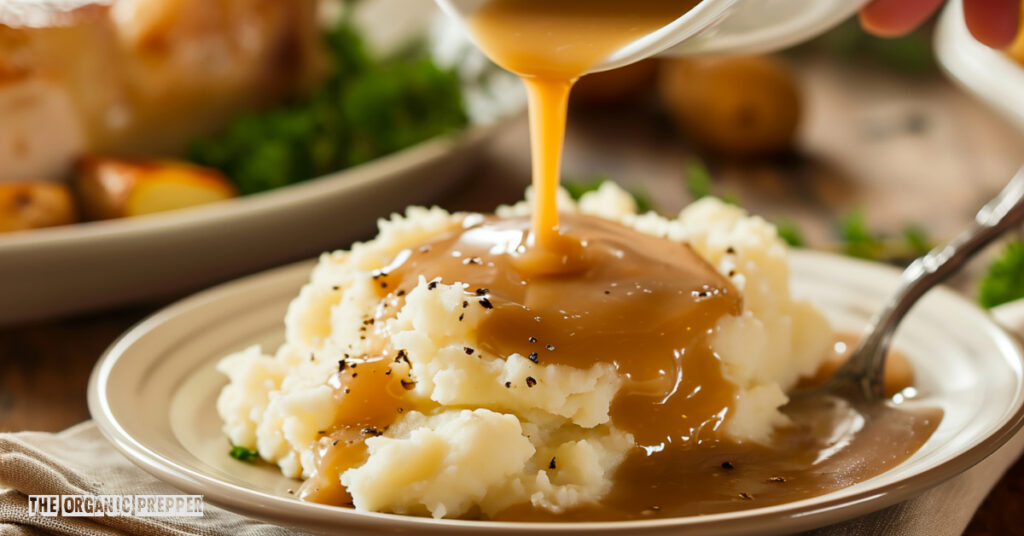
Maybe it’s because I grew up in the South, but to me, nothing helps stretch a meal, pull things together, or disguise less than stellar quality food like gravy. You can put gravy on just about anything and suddenly, the meal feels far more hearty.
I make two basic kinds of gravy – brown gravy and white gravy.
Both are pretty similar to start out with. You are going to brown some flour in some fat. It’s what you add next that changes things. For brown gravy, broth is the gold standard for a rich, savory gravy. However, if times are tight, water, salt, and pepper can make a fine gravy as well. For white gravy, you’ll be adding milk, salt, and pepper for a creamy, flavorful sauce. In difficult times, I usually use water and a couple of tablespoons of powdered milk for my white gravy. (Keep reading – the specific recipes are below.)
Find these recipes and more ideas in my book, What to Eat When You’re Broke.
How can you use gravy?
Gravy goes with just about anything at our home. But here are a few specific ideas.
Brown Gravy:
Subscribe to our newsletter
Trying to figure out how to stock up while prices keep climbing? We can help with our free guide and newsletter!
- Simmer hamburger patties or cube steaks in brown gravy and serve over mashed potatoes or rice. You can add some sauteed onions, mushrooms, and/or peppers to this dish to extend it inexpensively. This can also be cooked in the crockpot.
- Top French fries with brown gravy. If you want to be Canadian, add cheese curds before you add the gravy (or shredded cheddar).
- Make your roast go further by making gravy from the drippings or cooking liquid.
- Meatballs and gravy are delicious served over noodles
- I always make brown gravy with the drippings from a roasted chicken and drizzle it over everything on my plate.
- Meatloaf is lovely with gravy
White Gravy:
- The eternal Southern classic: biscuits and gravy – use a small amount of bacon or sausage to get your drippings, then crumble the meat into the gravy at serving time.
- Chicken-fried steak with white gravy
- Shredded chicken in white gravy (you can either top it with biscuit dough or serve it over potatoes)
- Pork chops – if you make shake-and-bake style pork chops from a thinner cut of meat, white gravy will make the meal more filling (and tastier).
- Fried chicken with mashed potatoes and white gravy is another Deep South classic.
Any Gravy:
- Add gravy to vegetables and leftover meat then put it inside a pot pie.
- Add gravy to leftover meat, vegetables, and grains, then thin the gravy with broth or water to make a leftover stew. Serve with bread.
- Bread and gravy: my dad grew up during the Great Depression. For him, a favorite meal was a slice of bread (from a storebought loaf) drenched in any kind of gravy. (This is a good way to use up leftover gravy – I read some people actually have leftover gravy!)
How to make brown gravy
This is how to make a simple brown gravy.
Ingredients
- 2 tbsp of meat drippings
- 3 tbsp of flour
- Salt and pepper to taste
- 2 cups of broth, drippings, or water
Directions
- Add drippings to a saucepan and turn the heat on your stove to medium.
- When the drippings are hot enough that a tiny bit of water splashed into the skillet off your fingertips sizzles on contact, use a whisk to mix in 2 tbsp of flour. Whisk vigorously until the flour and fat are completely incorporated with no lumps. You should end up with a smooth, creamy-looking mixture. (This is called a roux.)
- Stir in the water or broth. Broth gives a slightly richer flavor, but gravy made with water is still delicious and much more frugal. Using the whisk, mix the roué and water thoroughly.
- Cook, whisking almost continuously, for 3-5 minutes until your gravy reaches a uniform consistency and the desired thickness. If it is too thick, whisk in more liquid, half a cup at a time.
- Keep warm over the lowest heat your stove allows.
Gravy rocks because it can make a lesser cut of meat taste delicious. Your gravy leftovers (if you have any) can be used as the basis of a nice soup or stew. Some folks like to add a little bit of packaged brown gravy mix or bouillon paste to make it taste richer.
How to make white gravy
The directions for white gravy are almost identical to making brown gravy.
Ingredients
- 2 tbsp of meat drippings
- 3 tbsp of flour
- Salt and pepper to taste
- 2 cups of milk or 2 cups of water and 4 tbsp of powdered milk or 1 cup of water and 1 cup of milk
Directions
- Add drippings to a saucepan and turn the heat on your stove to medium.
- When the drippings are hot enough that a tiny bit of water splashed into the skillet off your fingertips sizzles on contact, use a whisk to mix in 2 tbsp of flour. Whisk vigorously until the flour and fat are completely incorporated with no lumps. You should end up with a smooth, creamy-looking mixture. (This is called a roux.)
- If you are using milk powder, whisk that into your roux.
- Stir in the milk or water. Using the whisk, mix the roué and milk or water thoroughly.
- Cook, whisking almost continuously, for 3-5 minutes until your gravy reaches a uniform consistency and the desired thickness. If it is too thick, whisk in more liquid, half a cup at a time.
- Keep warm over the lowest heat your stove allows.
If you are from the South, you know that this kind of gravy goes with fried chicken, mashed potatoes, breakfast sausage, and/or biscuits.
How do you use gravy?
I really think gravy is the best frugal condiment around. Are you a fan of gravy? How do you serve it? Share your gravy tips here in the comments.











7 Responses
My late very Southern MIL had a recipe for what she called chocolate gravy, made with cocoa powder and orher ingredients. She was very protective of that recipe, saying it was her mother’s recipe.
After 10 years of marriage to her son, I finally convinced her to write down the recipe on paper and give me a copy. Unfortunately, I have lost the recipe over the years due to moving.
It reminded me of a dessert gravy, if there is such a thing as a dessert gravy. MIL would pour it over fresh baked biscuits or occasional angel food cake.
I love brown gravy! A long time ago, I was taught to lightly brown plain flour in a hot skillet, stirring the flour constantly until it was a golden brown. Then the skillet was removed from the heat & the browned flour allowed to completely cool back to room temperature. The browned flour was stored in a glass jar. The browned flour was used to make gravy or thicken soups or stews. Browned flour did not clump or make lumpy gravy. And browning added just a smidge more flavor & a lovely rich color to anything we added the flour to.
The holy grail for anemic-looking gravy is Kitchen Bouquet–makes any gravy look (possibly taste?) much more appealing! A few drops into turkey gravy (for instance) really ups it’s visual appeal.
Yeah, read on survival sites to liven up food to know a bunch of gravy recipes. Can make a difference between enjoying something and NOT enjoying it.
One of the most important uses of gravy in our house is for smothering, particularly smothered pork chops. I’ll sometimes make smothered chicken, but the chops are one of my husband’s favorites. They are his annual birthday dinner request.
My late parents, Depression era babies, having grown up here in rural Middle Tennessee, would often prepare a special breakfast on Christmas Day, consisting of our special Tennessee smoked sausage, fried potatoes, eggs, Mom’s homemade biscuits, and of course, what we called milk (or cream) gravy.
Yummy – that sounds incredibly delicious!