By the author of Household Preparedness Training: Domestic Protocols For Crises And Emergencies
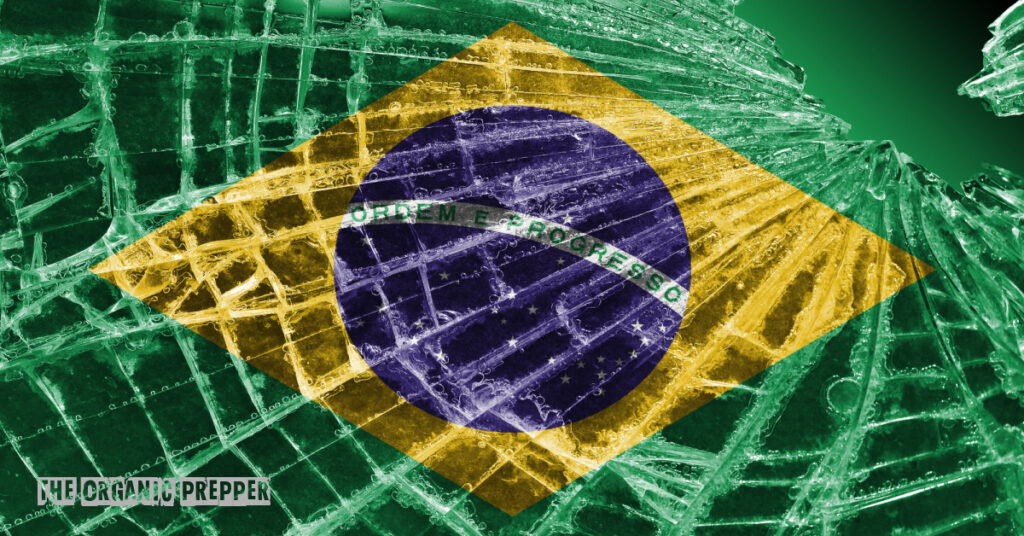
I was writing an article about the erosion of stability, but decided to put it on hold until the general elections in Brazil that took place last month were over. Not for political reasons, but because those issues are linked and the outcome had potential to confirm my points.
Unfortunately I must report it’s illustrating them, so I decided to keep the title.
In case you missed the news and the (largely critical) reactions in the international press and social media, the presidential runoff was tumultuous. Today my country is even more divided and confused than before.
There’s something more sinister behind the erosion of stability in Brazil than the elections, however, as I’ll show in a moment. For now, here’s a summary of last week’s events:
Conservative runner and senator Flavio Bolsonaro – son of former president Jair Bolsonaro – won the first round by 2,7 million votes over leftist incumbent Lula. Right-wing parties swept Congress and elected fifteen governors from a total of twenty-seven states – six by Bolsonaro’s PL party alone.
Brazilian press called the 2026 general election a conservative tsunami. All polls indicated a win, potentially by even bigger margins as Flavio gathered support from three eliminated right-leaning candidates. The left was despondent.
Subscribe to our newsletter
Trying to figure out how to stock up while prices keep climbing? We can help with our free guide and newsletter!
Then on Sunday 25 Lula took the runoff and won his fourth mandate by 4,4 million votes, an astonishing recovery by all measures. I had the impression the president himself seemed surprised as he watched the count flip into his favor.
Though no proof of fraud has surfaced, the whole story of how Lula and his acolytes turned an almost certain defeat into a massive win is marred by the meddling of the Supreme Court, the wavering and neglect of the Electoral Tribunal, and a campaign based on lavish spending of public money, populism, lies, manipulation, and fear-stoking.
That, and the winning margin – a statistical anomaly never seen since Brazil became a democracy again in 1989 after two decades of military government – had the opposition up in arms and the independent press crying foul. Even Elon Musk chimed in (for the curious, a quick analysis of the peculiar math behind it can be found here and here).
In his typical fashion, Lula made sure to rub salt in the wound by doubling down on his radical, divisive speech and recycling authoritarian ideas in his winning discourse, while his party – emboldened by the victory – took an even more belligerent stance against the opposition.
Back in the real world, the Brazilian trading index crashed 20% on the international market while the real dropped almost 10% against the dollar following Lula’s confirmation. The local stock market suffered a historic drop, plunging 17% on Monday morning, triggering the circuit breaker for the first time since Covid.
However, Lula is not the main reason why Brazil 2026 is fast becoming Venezuela 2004.
What’s done is done and barring a miracle – Lula, his secretaries, supporters, and enablers doing a 180 on pretty much everything they’ve done for the last two and a half decades – we’re officially in for another four years of economic and fiscal fuckery, reckless populism, failed policies, taxation, and corruption scandals which may finally drive Brazil into the cliff – yet again.
However, even more concerning is the political activism and witch hunt carried out by a sector of the Supreme Court to protect congressmen, members of the government and some of its own justices all suspected of involvement in billion-dollar corruption scandals.
That’s what’s been running over the Constitution and eroding stability for the last seven years.
They’re not even hiding it anymore: only seven minutes after the release of results, Supreme Court justice Alexandre de Moraes summoned Flavio Bolsonaro to hand out his passports, prohibiting him to leave the country.
A senator in office with no charges and a presidential candidate who on that same day received 60 million votes.
If that’s an indication of things to come, we’re definitely headed for even darker times.
Forewarned, Bolsonaro fled the country with his family to seek asylum in the U.S., joining his brother and former congressman Eduardo and hundreds of Brazilian citizens plus a dozen journalists, justices and congressmen and women prosecuted by the Supreme Court since 2022.
The courts of Italy, Spain, Argentina, Peru and the U.S. unanimously rejected all extradition requests by Brazilian justice, judging the cases as political persecution. Despite international humiliation, the Supreme Court keeps Bolsonaro father homebound (i.e., imprisoned), isolated and muzzled in Brazil.
Every democracy has its hiccups and setbacks, but that’s a situation only seen in totalitarian regimes.
Looking ahead, the election of a right-leaning senate will likely increase the potential for more and serious strife between the executive, legislative and judiciary, similar to what’s happening in Poland.
And it gets worse: during his next term Lula will have the prerogative to appoint at least four new justices to the Supreme Court, further consolidating his and his peers’ influence over an already partial, overstepping and authoritarian branch.
That’s the situation in a nutshell.
On Monday I woke up and went about my routine as usual. Everything is working as before, but something’s weird and there’s a different tension in the air. I’ve lived part of my life under a strict military regime, and while the current situation is different in many ways, I feel I no longer live in a free country.
If you live in the U.S., Canada, Australia or Europe you might be wondering why you should care about events taking place outside your country.
People here and in fact everywhere ponder the same, too. “Why should I follow what happens in X, Y or Z if I live distant in W”?
I get asked that all the time. My answer is, no one has to. The majority won’t and that’s fine. But preppers aren’t the majority, and some situations present warnings and lessons for everyone, everywhere. Those who aren’t listening cannot connect the dots and will be blindsided.
It’s not about following everything that happens abroad, or in detail. That’s a distraction and a waste of time.
We should pay attention to changes and movements taking place underneath the surface in places like the Middle East, for instance. Or China, if you will. But here I’m talking something more immediate: staying minimally informed about significant occurrences and trends in places with similar cultural, economical and political contexts, and analyzing that against our own. That’s an exercise that should have a place in your playbook.
Things don’t happen the same way every time, or everywhere, but certain dynamics repeat, or as we say history rhymes. We don’t control the system’s agenda, but we can be attuned and work to prepare and adapt.
It’s said you can vote your way into communism, but not out of it. Looks like Brazil is about to find out.
Some say Brazil is a lab for globalist experiments. That’s so beyond me I can’t even be bothered to comment. What I can say is, while not really Third World, Brazil has a detrimental combination of weak institutions, a hard-working yet compliant (and unarmed) population, and longstanding, unresolved structural issues.
I’d add “a significant pro-left portion of leaders, influencers and people” to the above. But that seems to be a default feature in many Western democracies these days, so consider it an equalizer, and one of the reasons why many banana republic issues aren’t exclusive to banana republics anymore.
Or is most of the Western world turning into one, which yields the same results (Thirdworldization)? The answer may be found in the situation of Europe, North America and other places.
In some countries the system will be responsible for open borders. In others, for the destruction of a perfectly functional energy matrix. Or the rigging of elections, political and ideological persecution, exploding sovereign debts, irresponsible spending of public money, wars, and so on. Oftentimes it will be a combination of many, or all of these.
In every case, it will weaken institutions, stifle the economy, stretch the social fabric, fostering discontent, resentment and anger among the population. That’s spreading in the western, and we haven’t reached tipping point yet.
I’m not affirming this or that will happen where you live. It may, or not – you should be able to judge. I’m simply reporting on a situation and providing my perspective, so you’re aware of what is happening out there, and the dynamics of it.
The problems may differ in different locations, but at the core they have the same causes and yield similar consequences. That’s my message, you make with that what you will.
Final Considerations
Despite what you and I think about democracy or elections, they are a fixture in most Western nations, and that won’t change anytime soon, so we’re better off coming to terms with reality and doing our best. Besides, I can affirm it’s is still a better system than totalitarianism or anarchy. If you don’t believe me, ask Selco or Jose.
However, for elections to be considered legitimate and satisfactory by the population and institutions, thus fulfilling their role in civil conciliation, appeasement, and continuity, the process is as important as the results.
If the process was tainted, so are the results; regardless of who wins and all the practical consequences of that, when there are more questions than answers, distrust gets installed, and wounds don’t heal. The nation goes on divided.
The general elections didn’t alleviate social tensions that have been mounting in Brazil for some time. If anything, they did the exact opposite, for the reasons reported.
Not that it would be much different if Bolsonaro had won – also for the same reasons. But as it happened, there are now a lot of asterisks and ifs stretching the cord even tighter, and further radicalization on both sides.
We have a result, but no satisfaction nor peace, and definitely no stability. Where that will lead, I have no idea.
About Fabian
Fabian Ommar is a 50-year-old middle-class worker living in São Paulo, Brazil. Far from being the super-tactical or highly trained military survivor type, he is the average joe who since his youth has been involved with self-reliance and outdoor activities and the practical side of balancing life between a big city and rural/wilderness settings. Since the 2008 world economic crisis, he has been training and helping others in his area to become better prepared for the “constant, slow-burning SHTF” of living in a 3rd world country.
Fabian’s ebook, Street Survivalism: A Practical Training Guide To Life In The City , is a practical training method for common city dwellers based on the lifestyle of the homeless (real-life survivors) to be more psychologically, mentally, and physically prepared to deal with the harsh reality of the streets during normal or difficult times. He’s also the author of The Ultimate Survival Gear Handbook.
You can follow Fabian on Instagram @stoicsurvivor